How to Build a Trading Playbook from Your Own Reviews
Here's what my playbook looks like at 9:15 ET, before the open:
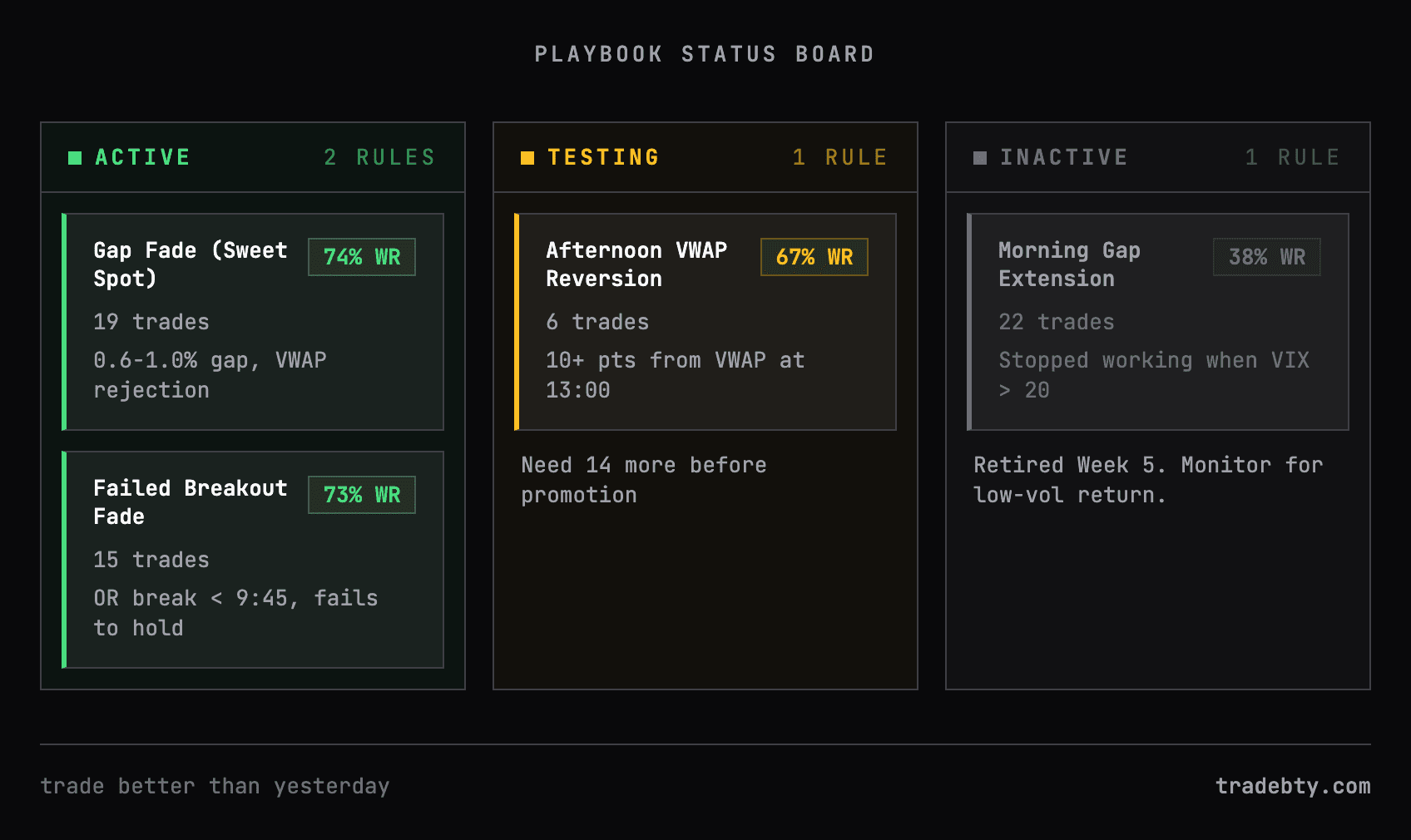
Active Rule 1: Gap Fade (Sweet Spot)
IF gap between 0.6% and 1.0% AND VWAP rejects 2x in first 20 min, THEN short on 3rd touch. Stop above the high of the rejection candle, minimum 2 points above VWAP. Target: prior day close.
Status: 14 wins, 5 losses (74%). Active since Week 2.
Today: Futures show 0.7% gap up. Rule is live.
Active Rule 2: Failed Breakout Fade
IF opening range breaks before 9:45 ET AND price fails to hold above the OR level for 2 minutes, THEN fade back into the range. Stop 2 points above the failed breakout high. Target: opposite side of the opening range.
Status: 11 wins, 4 losses (73%). Active since Week 3.
Today: Will monitor if OR breaks early.
Testing Rule: Afternoon VWAP Reversion
IF price is more than 10 points from VWAP at 13:00 ET AND TICK (measuring real-time upticking versus downticking NYSE stocks) crosses back above -200 from below -400, THEN enter mean reversion toward VWAP. Half size. Target: VWAP. Stop: 5 points beyond the session extreme.
Status: 6 occurrences. 4 wins, 2 losses. Need 14 more before promotion.
Today: Log if condition appears. Half size only.
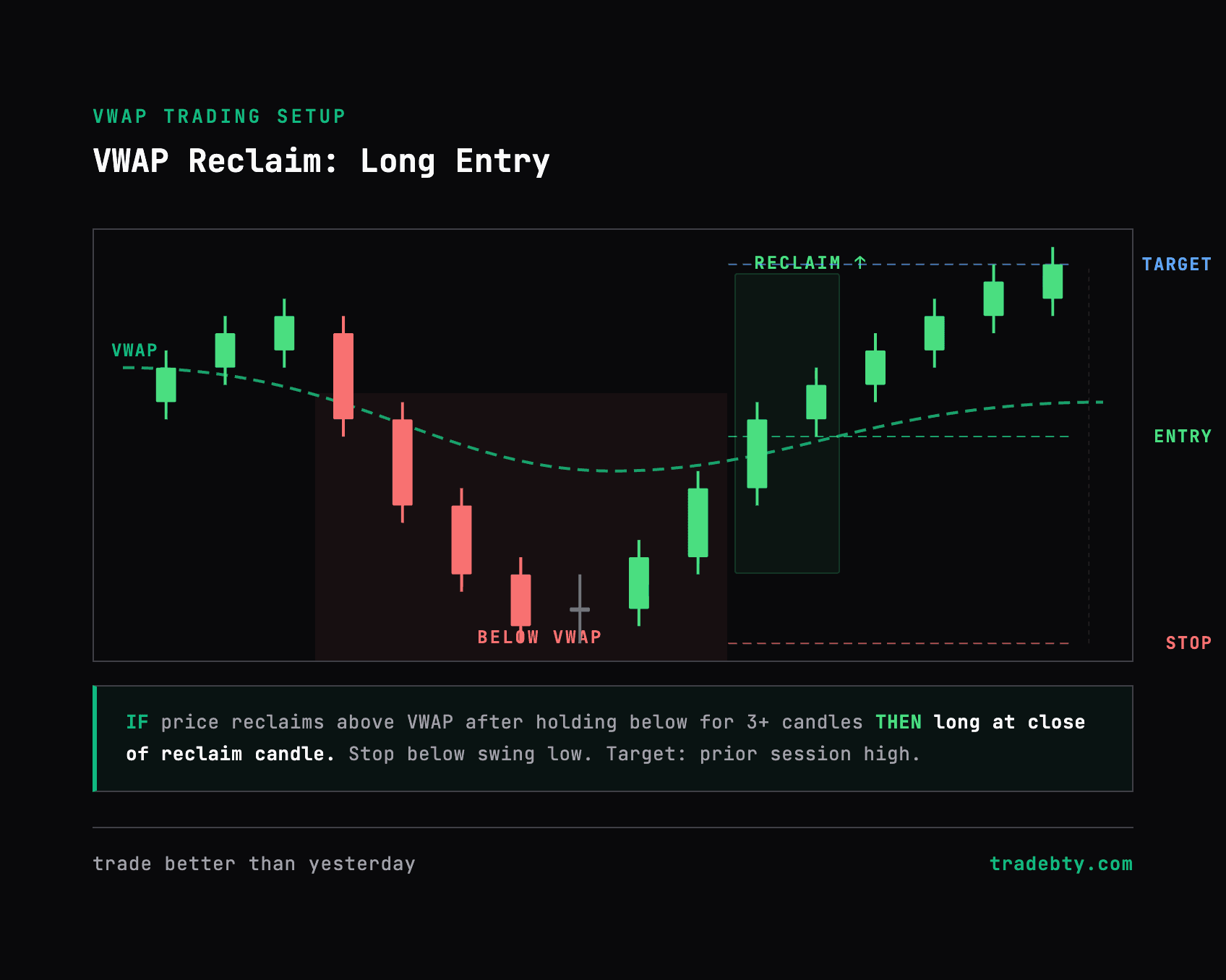
Three rules. Each one has a measured win rate, a defined trigger, a specific action, and a clear status. I'm not scanning for random setups. I'm waiting for one of my three rules to fire.
It took months to get here. I drafted maybe 15 rules before these three survived. Some died in testing. A few never triggered again. One looked great for 10 occurrences and went 1-for-6. That's normal. The playbook you end up with is built from the wreckage of rules that didn't make it.
What a Playbook Is (and Isn't)
A playbook is not a list of setups. It's not a screenshot folder of chart patterns you liked. And it's definitely not "buy when RSI is below 30."
A playbook is a set of conditional rules, each with a tracked outcome. Every rule has an IF (the conditions), a THEN (the action), a stop, a target, and a running scorecard. The scorecard is the part that makes it a playbook instead of a wishlist.
Most traders I talk to have something they call a playbook. When I ask to see it, it's usually a collection of setups -- "VWAP bounce," "opening range breakout," "trend day continuation." These are categories, not rules. A category tells you what to look for. A rule tells you exactly when to act, what to do, and when to stop.
The difference matters because categories can't be tracked. You can't measure the win rate of "VWAP bounce" -- it's too vague. But you can measure the win rate of "IF price touches VWAP for the third time before 10:30 ET with TICK above +200, THEN enter long with stop 2 points below VWAP, target prior session high." That's a rule. After 20 occurrences, the data tells you whether it works.
If your current playbook doesn't have win rates attached to every entry, it's a setup list. Setup lists feel organized. They don't improve your trading.
The Lifecycle: Observation to Active Rule
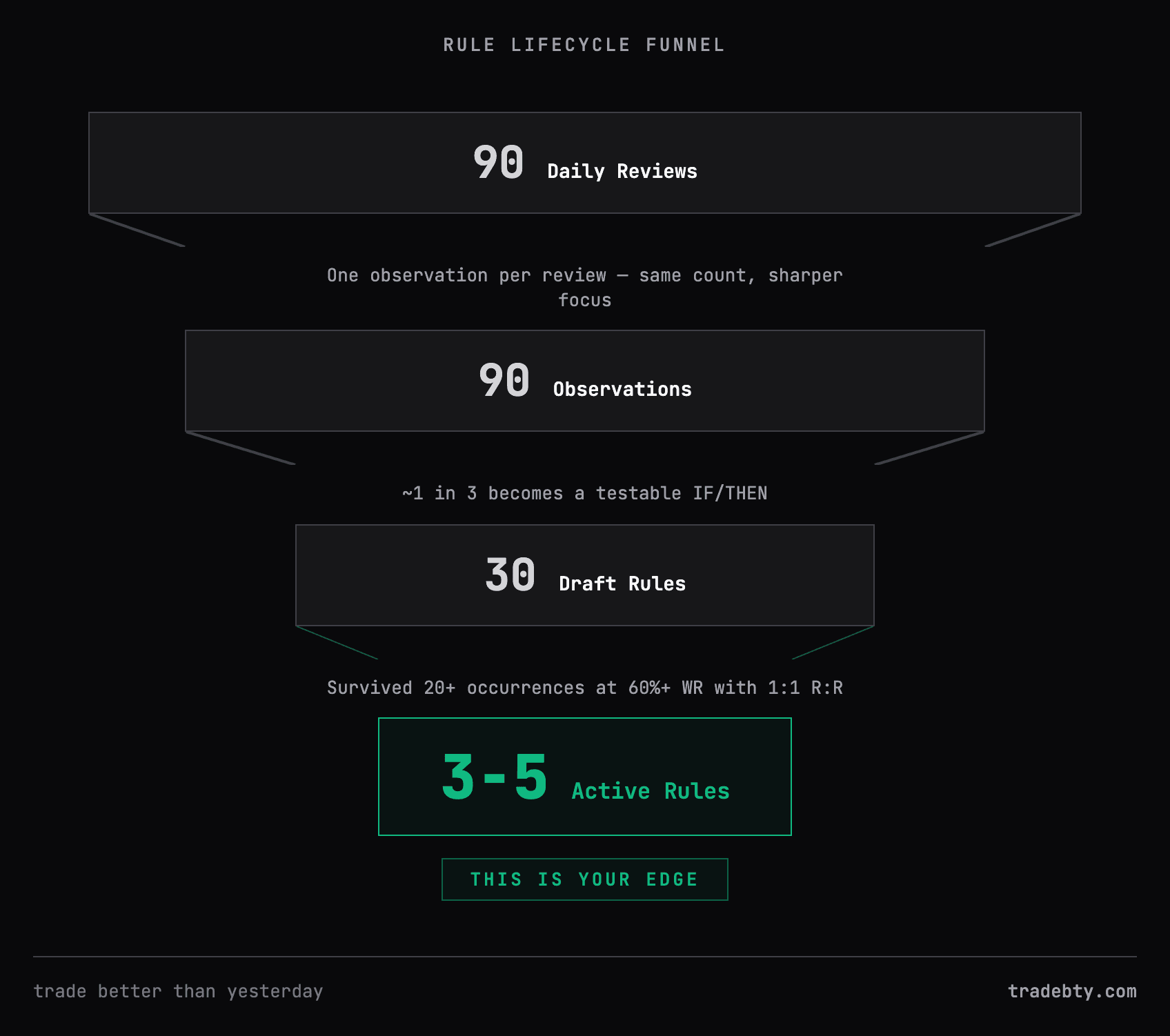
Every rule in my playbook started as something I noticed during a review. The lifecycle looks like this:
Observation. You finish a session and something stands out. Maybe ES rejected VWAP three times before noon, and each rejection held for at least a minute before selling off. You mention it in your voice review. That's raw material.
Hypothesis. You take the observation and encode it as an IF/THEN. "IF price rejects VWAP 3x before noon with at least 1-minute holds, THEN short with stop above the rejection high." This is a draft. It might be wrong. That's fine -- you're not trading it yet.
Testing. You track the rule for 20 occurrences. Every time the condition appears, you log it -- whether you traded it or not. This is the hardest part because it means writing "N/A, no signal" on slow days and logging the trade you skipped because you hesitated. (For the full pipeline from observation to tested rule, see turning observations into testable rules.)
Promotion or retirement. After 20 tracked signals, the data decides. 60%+ win rate with reasonable R:R? Promote to Active. Below 40%? Refine or retire. Between 40-60%? Look for a sub-condition that tightens it.
Active or inactive. Active rules get traded at full size. When decay signals appear -- recent win rate drops, three consecutive losses, regime shift -- the rule moves to Inactive. Not deleted. Shelved until conditions return. (For more on spotting decay, see when setups stop working.)
This lifecycle is the entire point. Without it, your playbook is static. With it, your playbook evolves as the market evolves.
The Three Categories
Every rule lives in one of three buckets.
Active -- 60%+ win rate with at least 1:1 average R:R over 20+ occurrences. Still working in the current regime. Full size. Three to five active rules is enough.
Testing -- Fewer than 20 occurrences. Promising but unproven. Log every signal, whether you trade it or not. Half size only. Most rules never graduate, and that's fine -- means the bar is high enough.
Inactive -- Win rate dropped below 40% recently, or the regime shifted. Don't trade these. Don't delete them either. A rule that stopped working in high volatility might come back when volatility drops.
Where Rules Come From
They come from your reviews. You notice a pattern, talk through it in your voice review after the close, and the AI drafts it as a conditional rule. You refine it, start tracking -- and half the time it fizzles by occurrence 12. That's the process working.
The full pipeline from observation to tested edge is covered in turning observations into testable rules. Knowing when a rule has decayed is covered in when setups stop working.
How to Measure If a Rule Works
This is where most playbook advice falls apart. People say "track your setups" but never explain what good data looks like.
Sample size matters. Five trades is noise. Ten trades is still noise. You need at least 20 occurrences of a rule before the win rate means anything. At 20, you can start to see if there's a real pattern. Below that, you're reading tea leaves.
Track signals, not just trades. Log every time your rule's conditions appear, whether you traded it or not. The signals you skipped are just as important as the ones you took. If you skipped three winners because you were spooked from yesterday's loss, that's not a rule failure -- that's a compliance failure. Plan Compliance catches this. A raw win rate won't.
Win rate isn't everything. A rule that wins 55% of the time with 2:1 average R:R is better than a rule that wins 75% with 0.5:1 R:R. Track both win rate and average reward-to-risk. Together, they give you expectancy -- the average amount you make per occurrence. Use a risk/reward calculator to check the break-even win rate for any target R:R, and a profit/loss calculator to see what the real take-home looks like after commissions.
When to kill a rule. If a rule's win rate drops below 40% over the last 7 occurrences, it's on watch. Three consecutive losses? Move it to Inactive. Don't wait for the lifetime average to catch up -- lifetime is a lagging indicator. Recent performance is what matters. Give it 20 clean occurrences in the new regime before reactivating.
Common Playbook Mistakes
I've made all of these. Sharing so you don't have to.
Too many rules. I tried running 12 patterns borrowed from trading books and forums. At 9:37 ET with a chart moving fast, I couldn't remember which one applied. The three rules I'd built from my own reviews? Those I knew cold. Three to five active rules is the ceiling. If you need more, your filters aren't tight enough.
Rules too vague. "Buy when price reclaims VWAP" is not a rule. When? After how many touches? With what confirmation? What's the stop? Vague rules can't be tracked. If you can't explain the exact trigger to someone else and have them identify the same signal on a chart, it's too vague. (This is the same problem as writing "be patient" in your journal -- sounds like a plan, does nothing in practice.)
Never retiring dead rules. I used to skip the weekly cleanup. Dead rules piled up, cluttered my morning selection, and diluted my focus. A rule that hasn't triggered in two weeks is either too narrow or the market moved past it. Move it to Inactive. You can always bring it back.
Borrowing rules you haven't tested. Someone in a Discord shares their VWAP fade setup. It worked great for them. You add it to your playbook and trade it full size on Monday. This is how you lose money with someone else's edge. Every rule needs 20 tracked occurrences in your own data, on your own instrument, in your own regime. No shortcuts.
Promoting too early. A rule goes 4-for-5 and you move it to Active. That's 5 occurrences -- statistically meaningless. At 20 occurrences, you'd have caught the 6 losses hiding behind those first 5 wins. The 20-occurrence bar exists for a reason. Respect it.
The Daily Loop: Morning Select, Evening Grade
A playbook only works if you use it daily. This is the closed loop.
Morning: Your Execution Script loads first -- max loss, sizing rules, what you will and won't trade. Then you select 1-3 rules from your active playbook that match today's context. (The full morning prep routine walks through this step by step.) Gap size, VIX level, overnight structure filter which rules are live. State Gate checks your readiness before any of it matters.
Evening: Grade each selected rule after the close:
- -Worked -- rule triggered, positive outcome.
- -Failed -- rule triggered, negative outcome.
- -N/A -- rule didn't trigger today.
Plan Compliance asks the harder question: did you follow the plan? Did you trade something that wasn't in your morning selection? Did you skip a rule that triggered because you were spooked from yesterday?
N/A isn't filler. A rule graded N/A for two straight weeks tells you the market moved past it or your filters are too narrow. Often visible before a single loss shows up.
Weekly Cleanup
Once a week, review every rule's recent grades:
- -Keep -- still triggering, still working.
- -Refine -- triggering but outcomes are mixed. Tighten a filter.
- -Kill -- not triggering, or consistently failing. Move to inactive.
I used to skip this. Dead rules piled up, cluttered my morning selection, and diluted my focus. Now it's a Sunday evening habit. Fifteen minutes.
Small Beats Large
You don't need 20 setups. I tried that once -- had 12 patterns borrowed from trading books and forums. At 9:37 ET with a chart moving fast, I couldn't remember which one applied. The three rules I'd built from my own reviews? Those I knew cold.
Start with one tested rule. Add a second when you've earned it. Three to five rules built from your own data, where you know the conditions and the failure modes -- that's more edge than most traders ever build.
TBTY builds your playbook from your voice reviews. Talk after the close, rules get extracted and tracked, and your morning prep loads only what's relevant today. $9/mo founding rate, locked for life. Free tier: 7 reviews and 3 playbook rules. Start here.
Keep Reading
- -When Your Best Trading Setup Stops Working -- how to detect decay and move rules between tiers.
- -The 9-Section Trading Review Template -- the daily review that feeds new observations into your playbook pipeline.
- -Why Do I Keep Revenge Trading? -- building behavioral rules into your playbook, not just market rules.
TBTY is an educational approach to structured trading review. Examples use ES futures for illustration only. Past patterns do not guarantee future results. Trading involves risk of loss. Always do your own analysis.
Want the complete framework?
This article is adapted from the TBTY framework. Get the free Quick Start Guide delivered immediately — two core ideas that fix most reviews.
Get the Free Quick Start Guide