The 9-Section Trading Review Template That Replaces Your Journal
A blank journal page lets you skip the parts where you screwed up. Nine structured sections won't.
I spent months writing prose reviews. "Today was choppy. Shouldn't have taken that third trade." Six months later I had 120 entries and couldn't do a thing with them.
I couldn't pull up "every session where ES gapped above 0.5% and VWAP rejected twice." But a structured review can. Each section is a field. Fields let you search and compare across dozens of sessions instead of digging through old notes.
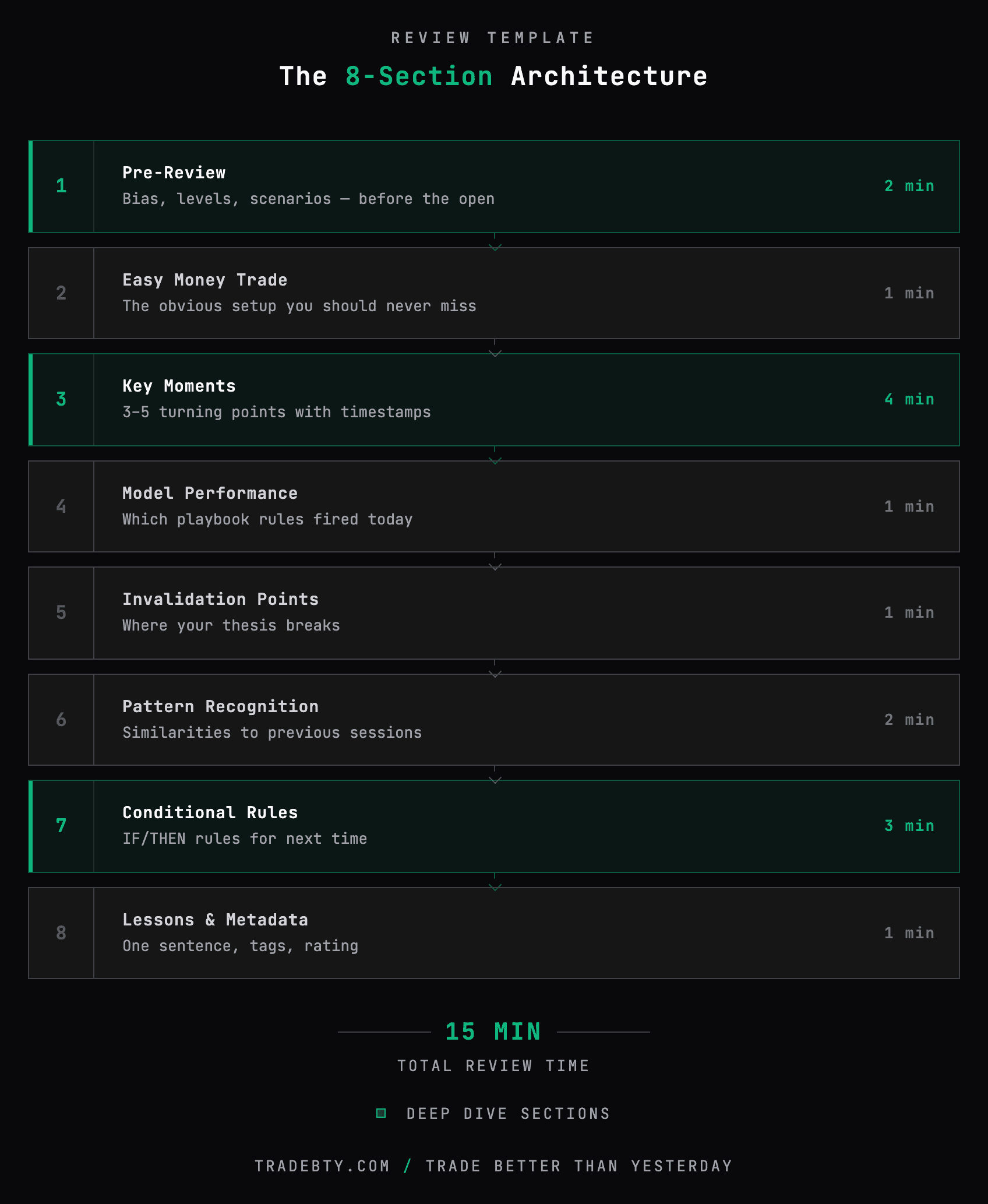
The whole thing takes 90 seconds of talking after the close. You record a voice note, AI populates the fields, and you review before saving. Nine sections sounds like a lot -- three carry most of the weight, and the rest are one-liners.
Why Most Trade Reviews Fail
Before the template, here's why your current journal probably isn't working.
You're reviewing P/L instead of process. A winning trade where you broke three rules teaches you nothing good. A losing trade where you executed perfectly is a success. If your daily trade review starts and ends with "I made $400" or "I lost $200," you're reinforcing outcome bias instead of building skill.
You skip losing days. Nobody wants to relive a red session. But the losers contain most of the signal. If you only review when things go well, your playbook is built on a biased sample. This selective review is one of the key reasons traders keep bleeding money without understanding why -- structured daily reviews break the cycle of repeated losses by making your behavior patterns visible.
You write vague notes instead of rules. "Be more patient." "Stop overtrading." These aren't actionable. They're wishes. If your journal is full of these, here's why that never changes anything -- and what to do instead.
You don't extract rules from observations. You notice something, write it down, feel productive, and never act on it. A trading review template forces you to convert observations into conditional IF/THEN rules that you can actually track. The full process for that is turning observations into testable rules.
Session Context (Before the Open)
The only section you fill in before the session. It captures your plan -- including where your thesis breaks -- so hindsight bias can't rewrite your memory later.
I resisted this for weeks. Then I looked at a trade where I swore I'd been bearish all morning. My Session Context said neutral-to-long. Hindsight is a liar.
Example -- filled in at 9:15 ET:
- -Overnight range: H 5435, L 5418 (17 points)
- -Key levels: 5420 (yesterday close), 5430 (rejected 3x yesterday)
- -Bias: Neutral-to-long -- held above 5420 overnight
- -Scenarios: (1) Gap < 0.3%: opening range breakout above 5435. (2) Gap > 0.5%: fade to VWAP. (3) Below 5420: flip bearish.
- -Invalidation: Thesis breaks if price loses 5418 on volume.
When the bell rings, you're comparing reality to a written plan instead of improvising.
What Happened (3-5 Turning Points)
This section does the most work. For each moment: time, price, what happened, what you did, what you should've done. This is where voice review earns its keep -- you're talking through the session while it's fresh, not reconstructing it an hour later.
Example:
- -9:42 / ES 5428: VWAP rejection after 2nd touch. Entered short. Good -- waited for confirmation.
- -9:58 / ES 5418: Hit target. TICK (measuring real-time upticking versus downticking NYSE stocks) stayed below -200 on the bounce -- weak buying. Exited full instead of trailing a runner. Price continued to 5410. Next time: leave a runner when TICK confirms continued selling.
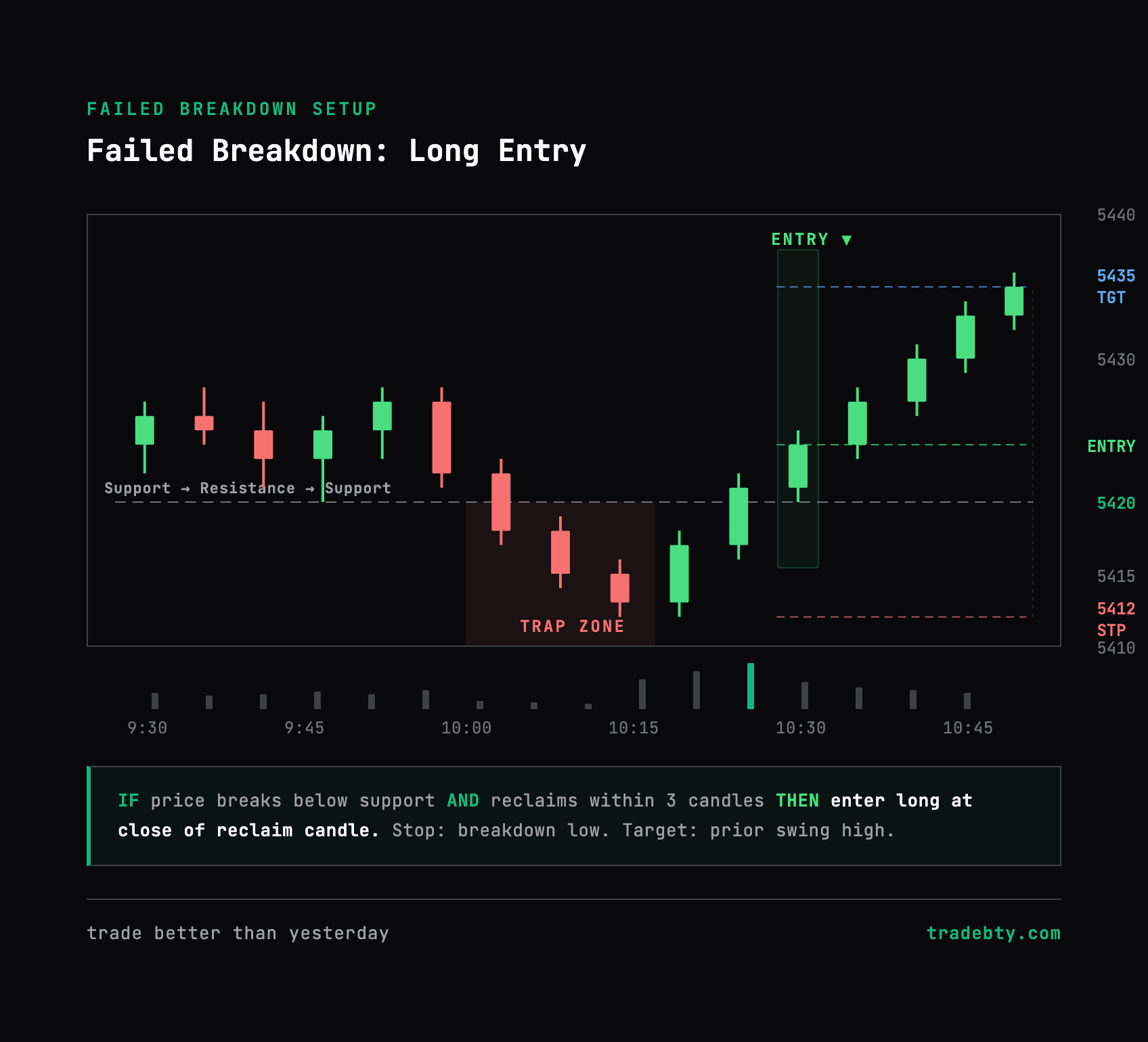
- -10:15 / ES 5412: Opening range breakout failed, price reversed back inside range. Didn't take the fade. Should've -- failure pattern was clean with a 6-point stop.
Three entries. Each has a timestamp and a verdict. After 30 sessions, you'll see exactly where your decision-making holds up and where it keeps falling apart.
Rules for Next Time (The Most Valuable Output)
Everything above feeds into this. One to three IF/THEN rules from today's session. This is the part that changes tomorrow.
Example:
- -IF the opening range is less than 10 points wide AND a 5-minute candle closes outside the range with ADD (the NYSE breadth indicator tracking advancing versus declining stocks) confirming direction, THEN enter in the breakout direction with a stop at the opposite side of the range. Target: 1.5x the opening range width, or the next key level.
Specific trigger. Specific action. Specific invalidation. Track it for 20 occurrences and you've got a win rate instead of a hunch. Pair the win rate with a target R:R -- use a risk/reward calculator to check your break-even -- and that's how rules earn a spot in your trading playbook. Through data, not gut feel.
If your current journal is full of vague notes like "be patient," here's why those never change anything -- and how conditional rules fix it.
The Other Six Sections (Quick Reference)
These are short. Most are a single line or two.
- -Trades: Which playbook setups fired today, whether you traded them or not. Logs entries, exits, and outcomes.
- -Easy Money Trade: The obvious setup of the day -- did you take it or miss it?
- -Plan Compliance: Did you follow your plan? Did you break a rule? Did you trade something that wasn't in your morning prep? This is the accountability loop that keeps your Execution Script honest.
- -Key Takeaway: The single most important lesson from this session. Not buried in metadata -- this loads into tomorrow's morning prep.
- -Patterns: Similarities to previous sessions. "Today's afternoon reversal looked like Tuesday and Thursday." Multi-day patterns surface here.
- -Session Rating & Tags: A 1-5 learning value rating and searchable tags, collapsed in the footer.
The 15-Minute Daily Trade Review
You're tired after the close. You have maybe 15 minutes before your focus evaporates. Here's how to use them.
Minutes 1-3: Record. Open a voice note. Talk through what happened. Hit the 3-5 turning points. Don't filter -- say what you actually did, not what you wish you'd done.
Minutes 3-5: Review the AI output. Your voice note gets structured into the nine sections. Scan each field. Fix anything the AI missed or misunderstood. This takes two minutes, not ten, because you're editing -- not writing from scratch.
Minutes 5-10: Grade. Score your Plan Compliance. Write the Key Takeaway. Tag the session. If a rule from your playbook triggered today, grade it as Worked, Failed, or N/A. This data feeds directly into tracking when your setups decay.
Minutes 10-15: Extract. Pull one IF/THEN rule from today's observations, or note that nothing new stood out. Not every session produces a rule. That's fine. Forcing one when there's nothing leads to low-quality hypotheses.
That's it. Fifteen minutes. Tomorrow morning, your morning prep routine loads yesterday's key takeaway automatically.
Voice Review vs. Typing
Most people default to typing because that's what journals look like. But typing is slow, and slow means you skip details or skip the review entirely.
Voice review works because it captures what happened while your short-term memory is still loaded. You talk for 90 seconds. The AI structures it. You spend your editing energy on accuracy, not generation.
The other advantage: you'll say things into a microphone that you'd never type. "I revenge-traded the third entry because I was pissed about the second one." That honesty is worth more than any technical insight. It surfaces the behavioral patterns that actually cost you money.
If you've never tried voice-based review, record your next session recap on your phone. Don't transcribe it -- just listen back the next morning. You'll hear things you didn't consciously register.
Minimum Viable Review
You don't need all nine sections on day one. Start with Session Context, What Happened, and one Rule for Next Time. That's one voice note after the close. Already more structured data than a month of free-form journaling. Add sections as the habit sticks.
The bar isn't perfection. The bar is: did you review today? A five-minute review done consistently beats a 30-minute review done twice a month.
Record a 90-second voice note. AI fills the fields. Review, tweak, save. That's it. And the next morning, your morning prep routine loads yesterday's key takeaway automatically.
TBTY is built around this template. Voice-first, structured output, fields that feed directly into tomorrow's morning prep and your playbook. $9/mo founding rate, locked for life. Free tier: 7 reviews and 3 playbook rules. Start here.
Keep Reading
- -How to Turn Trading Observations Into Testable Rules -- the pipeline that converts the rules you extract here into tested edge.
- -Why "Be Patient" Is the Worst Trading Advice -- why conditional rules beat vague journal notes every time.
- -Why Do I Keep Revenge Trading? -- the behavioral pattern your reviews will surface first.
- -Free Trading Journal Template -- what most spreadsheet templates get wrong and the 5 sections your journal actually needs.
TBTY is an educational approach to structured trading review. Examples use ES futures for illustration only. Past patterns do not guarantee future results. Trading involves risk of loss. Always do your own analysis.
Want the complete framework?
This article is adapted from the TBTY framework. Get the free Quick Start Guide delivered immediately — two core ideas that fix most reviews.
Get the Free Quick Start Guide