Why "Be Patient" Is the Worst Trading Advice You'll Ever Write
I went back through a month of my old journal entries. Here's what I found:
- -"Don't chase breakouts."
- -"Be more disciplined."
- -"Should have held the winner longer."
None of them changed a thing. I wrote them, felt productive, and repeated the same mistakes the next morning.
The observations were probably correct. They just weren't actionable. "Be patient" doesn't tell me anything when ES is breaking the opening range at 9:37 ET with weak internals.
Patient for how long? Until what signal?
Generic advice can't be tested. It evaporates the second the chart moves against you.
What People Actually Mean by "Be Patient"
When a trader writes "be patient," they're usually saying one of three things:
1. "I entered too early." The setup was forming but hadn't triggered yet. Price was approaching a key level, ADD was shifting, and you pulled the trigger before the confirmation candle closed. "Be patient" is your brain's shorthand for "the entry criteria weren't met."
2. "I forced a trade that wasn't there." Nothing in your playbook matched the conditions, but you took a trade anyway because sitting in cash felt unproductive. This isn't a patience problem. It's an overtrading problem -- and the fix is structural, not motivational.
3. "I exited too early." The trade was working, you had a clear target, and you bailed at the first 2-point pullback. This one isn't patience either. It's a missing exit rule. If your plan says "target is prior day high" and you close at half that, the fix is a trailing stop rule -- not a sticky note that says "hold longer."
All three are real problems. None of them are solved by "be patient." Each one has a specific mechanical fix. Lumping them under one vague label means you never identify which one you actually have.
Why Vague Advice Feels Productive
Writing "be patient" in your journal triggers the same satisfaction as actually fixing the problem. Psychologists call this the intention-behavior gap -- the plan feels like progress, so you never do the work.
I had 47 journal entries with some version of "be more disciplined" before I realized nothing had changed. I still entered early on breakouts. I still overtrade when the opening range is narrow. Forty-seven notes and zero improvement.
The reason is simple: vague advice can't be tracked. You can't look back after 20 sessions and ask "did being patient improve my win rate?" There's no data. There's no trigger. There's nothing to measure.
Compare that to a rule: "IF ES breaks the opening range before 9:45 ET, don't enter until price retests the breakout level and closes above it on a 1-minute candle." After 20 occurrences, you know the win rate. You know the average gain. You know whether the rule works. "Be patient" gives you none of that.
Conditional Rules: Patience With a Trigger
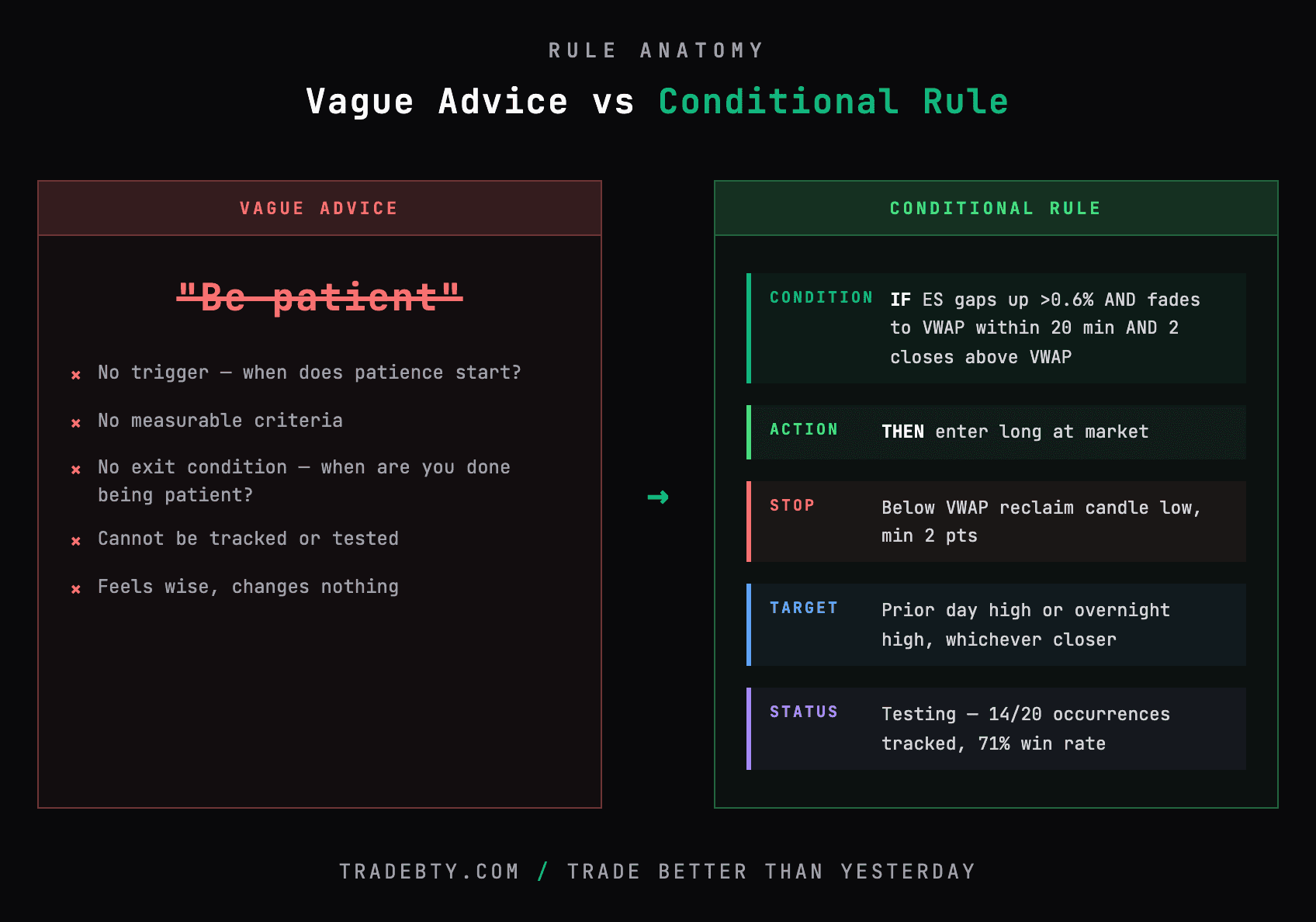
An IF/THEN statement with a trigger, an action, and an exit. Here's what the conversion looks like:
Vague: "Don't chase breakouts."
Actionable: "If ES breaks the opening range before 9:45 ET and price fails to hold above the breakout level for 2 minutes, don't enter. Wait for a retest and a 1-minute close above the level before going long."
Vague: "Be patient on gap days."
Actionable: "If ES gaps up more than 0.6% above prior day high and fades to VWAP within the first 20 minutes, only enter long after two consecutive 1-minute closes above VWAP. Stop below the low of the VWAP reclaim candle, minimum 2 points. Target: prior day high or overnight high, whichever's closer."
Vague: "Stop overtrading the open."
Actionable: "If the opening range (first 15 minutes) is less than 8 points wide, take zero trades until a 5-minute candle closes outside the range with ADD (the NYSE breadth indicator tracking advancing versus declining stocks) confirming direction. If no breakout by 10:00 ET, wait for the 10:30 reversal window."
Vague: "Cut losses faster."
Actionable: "If short thesis relies on rejection at a key level, exit immediately if price closes above that level on a 5-minute candle. No second chances, no widening the stop."
Every one of those actionable rules can be tracked. Log how many times the condition appeared, how many times the action worked, and you get a win rate. After 20 occurrences, you've got data instead of feelings. (For the full conversion pipeline, see how to turn trading observations into testable rules.)
Building Patience Into Rules, Not Willpower
Here's the trap: when traders say "I need more patience," they're treating patience as a character trait. Something you summon through willpower. That approach fails reliably, because willpower is a resource that depletes. By the third choppy hour of a range day, your willpower is gone.
The alternative is structural patience -- rules that force you to wait without requiring discipline in the moment.
Time-based gates. "No entries before 9:45 ET unless ES has already printed a 15-point opening range." This isn't patience. It's a filter. You don't have to resist the urge to trade the open -- the rule removes the decision entirely.
Confirmation requirements. "Enter only after a 2-minute hold above the breakout level with ADD confirming." The 2-minute hold is patience encoded as a condition. You're not sitting on your hands trying to be patient. You're waiting for a specific signal. There's a difference.
Daily trade caps. "Maximum 3 entries per day. After the third, close the platform." This one sounds crude, but it worked for me when nothing else did. It forced me to be selective because the supply of trades was limited. Eventually the cap became unnecessary because I'd trained the selectivity into my prep. But the cap was the scaffold.
Each of these replaces "try harder" with "build the constraint into the system." When the rule is the patience, you don't need the willpower. Your morning prep loads the rules, your session follows them, and your evening review grades compliance.
The Real Problem With Vague Notes
"Be more disciplined" feels like a lesson. It's actually a symptom. The discipline breakdown has a cause -- maybe you traded outside your plan because the State Gate should've flagged you (tired, tilted from yesterday's loss, skipped prep). Maybe you didn't have an Execution Script that morning, so there was no plan to be disciplined about.
Vague notes hide the mechanism. Conditional rules expose it.
When you write "be patient," ask yourself: patient about what? If you can't answer with a specific market condition, you don't have a lesson -- you have a feeling. Feelings are real, but they don't compound across sessions. Rules do.
Here's a simple test for any journal note: can someone else trade it? If you handed "be patient" to another trader, they'd have no idea what to do. If you handed them "don't enter OR breakouts until the 2-minute hold confirms with ADD above +400," they could execute it immediately. That's the bar.
Voice Review Makes This Easier
Here's why most traders never convert their observations into rules: by the time they sit down to write, the details are gone. Was the ADD at +500 or +300? Did the breakout hold for 2 minutes or 3?
A voice note right after the close captures the details while they're still sharp. "Breakout at 9:37, ADD was plus 500, held above OR for 2 minutes, ran 12 points." Thirty seconds of talking. The AI structures it into a conditional rule you can track. (The structured trading review template shows exactly what to capture in those 90 seconds.)
The voice note also catches things you wouldn't type. "I entered early because I was pissed about missing the first move." That sentence is worth more than a week of "be patient" notes. It tells you the problem isn't patience -- it's revenge trading after a miss. Different diagnosis, different fix.
The Conversion Exercise
Take one vague note from your last session and convert it. Write the IF/THEN with an exit. Track it for 20 occurrences.
If you can't convert it, that's a signal too. "Be more disciplined" might mean you don't have enough rules to be disciplined about. The fix isn't discipline -- it's building a playbook with enough specificity that "disciplined" means "followed the written plan."
Win rate above 60% with at least 1:1 R:R? Keep it. Below 40%? Refine or discard. Run the numbers through a risk/reward calculator to see the break-even win rate for your target R:R. Either way, you know -- and that beats "be patient" every time.
TBTY converts your voice reviews into trackable IF/THEN rules automatically. Talk after the close, get structured rules you can measure. $9/mo founding rate, locked for life. Start here.
Keep Reading
- -How to Turn Trading Observations Into Testable Rules -- the 3-step pipeline from vague observation to tracked IF/THEN rule.
- -The 9-Section Trading Review Template -- the structured review that forces specificity every session.
- -How to Build a Trading Playbook from Your Reviews -- where your conditional rules live after they pass testing.
TBTY is an educational approach to structured trading review. Examples use ES futures for illustration only. Past patterns do not guarantee future results. Trading involves risk of loss. Always do your own analysis.
Want the complete framework?
This article is adapted from the TBTY framework. Get the free Quick Start Guide delivered immediately — two core ideas that fix most reviews.
Get the Free Quick Start Guide