You searched "trading journal template free," downloaded a spreadsheet with columns for Entry, Exit, P&L, and Notes, filled it out for a week, and then stopped. Because after seven sessions, you had a table of numbers and a column of vague notes that told you nothing you didn't already know.
That's not a review. That's a trade log with a diary stapled to it.
The problem isn't that free templates are free. It's that they're designed to record outcomes, not diagnose process. And the difference between those two things is the difference between a trader who tracks P&L and a trader who actually improves.
What 90% of Free Templates Capture
Open any trading journal template from a Google search. You'll get some variation of this:
| Date | Ticker | Direction | Entry | Exit | P&L | Notes |
|---|---|---|---|---|---|---|
| 2/27 | ES | Long | 5,842.50 | 5,850.00 | +$375 | Good breakout |
| 2/27 | ES | Short | 5,855.00 | 5,858.25 | -$162.50 | Stopped out |
Congratulations. You now know you made $212.50 on Thursday. You already knew that from your broker statement. What you don't know:
- -Why did you take that long? Which playbook rule triggered it?
- -That short -- was it a setup you've tested, or did you chase a candle?
- -Were you already down when you entered the short? Did that affect your sizing?
- -What was your emotional state at entry? Calm, frustrated, bored, revenge-y?
- -Did either trade follow your plan, or were both off-script?
The P&L is the least useful column in your journal. It tells you what happened. It says nothing about whether you should do it again.
What a Trading Review Template Should Actually Capture
A journal that improves your trading needs five categories. Not ten. Not three. Five, because fewer than that misses critical data and more than that means you won't fill it out.
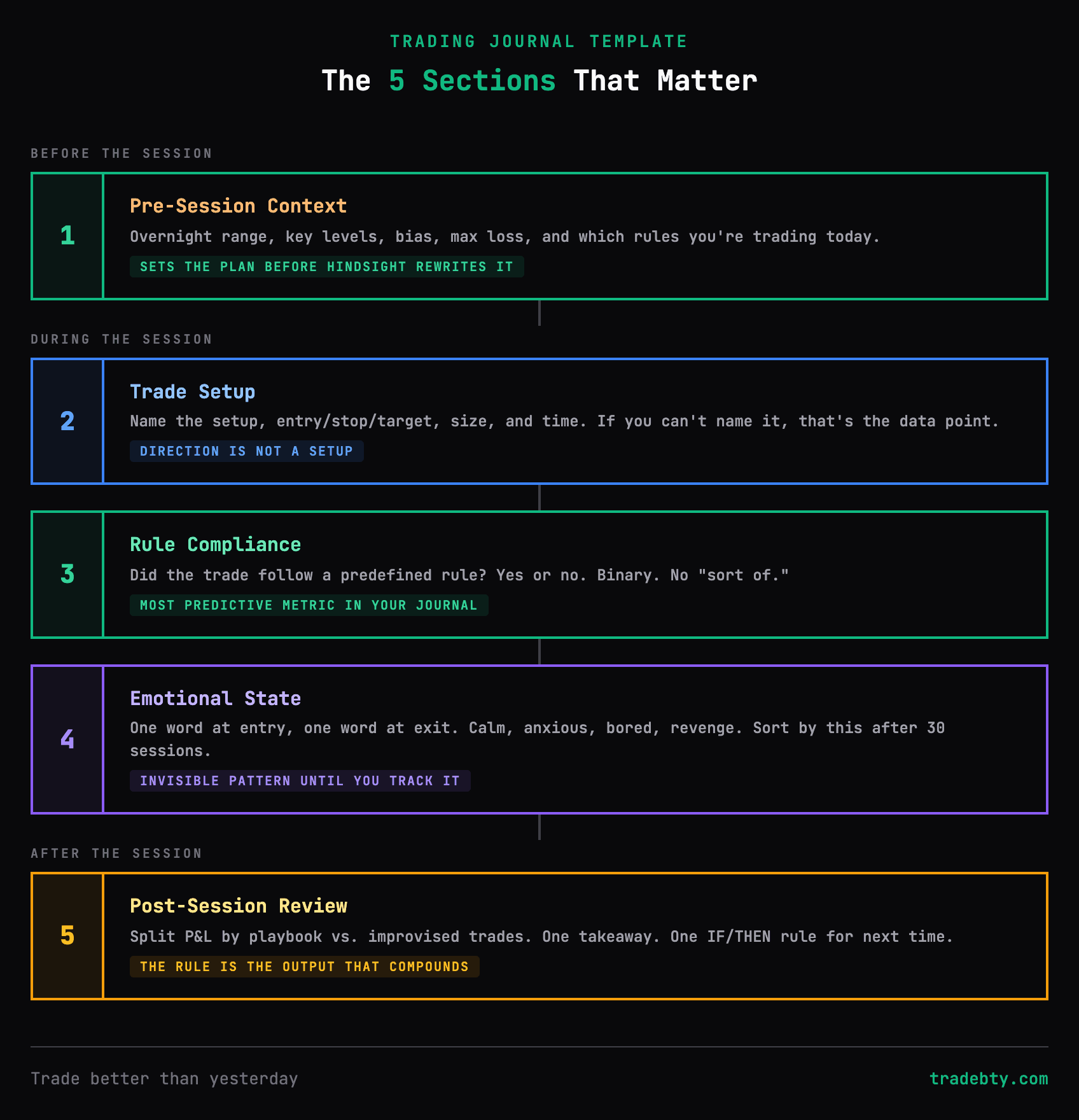
1. Setup Identification
Every trade needs a name. Not "long ES" -- that's a direction, not a setup. Something like "Opening range breakout above 5-min high with TICK > +400" or "VWAP mean reversion after 3rd touch."
If you can't name the setup, that's the most important data point of all. It means you took a trade without a reason. Those trades, in aggregate, are almost always net negative. The structured review template forces you to name the setup before logging anything else.
2. Rule Compliance
Did the trade follow a rule you've defined in advance? Yes or no.
This is binary. There's no "sort of." Either the setup met your predefined conditions or you overrode them. Tracking this across 20 sessions gives you the single most predictive metric in your journal: compliance rate. Traders with high compliance and tested rules make money. Traders with low compliance make excuses.
3. Execution Quality
You had the right setup. Did you execute it correctly?
- -Entry: Did you enter where your rule said, or did you chase 2 points late?
- -Stop: Did you place it at the defined level, or did you widen it "just a little"?
- -Target: Did you take profit at your target, or bail early out of fear?
- -Size: Did you trade the size your risk management says, or did you add contracts because you "felt confident"?
You can have the right setup, the right rule, and still blow the trade on execution. A free spreadsheet with an Entry/Exit column can't distinguish between "I entered at the right level" and "I chased 3 points because I hesitated."
4. Emotional State
One word at entry. One word at exit. That's all you need.
Calm. Anxious. Frustrated. Excited. Bored. Revenge.
After 30 sessions, sort your trades by emotional state and calculate P&L for each. Most traders discover that "calm" and "focused" trades are net positive, while "bored" and "frustrated" trades are a crater. That pattern is invisible without tracking it.
5. Context
What was the market doing when you traded? Not a full analysis -- just the facts that affected your decision.
- -Was it pre-10:00 ET high-volatility or post-11:00 mid-day chop?
- -Was the gap up or down? How large?
- -Were you already in a drawdown for the day?
Context turns isolated trades into comparable data points. "My breakout rule works 65% of the time before 10:30 ET and 30% of the time after 11:00" is actionable. "My breakout rule works sometimes" is not.
A Free Template You Can Use Right Now
Here's a template that captures what matters. Copy it into a spreadsheet, a Notion page, or a plain text file. The format doesn't matter. The fields do.
Pre-Session (fill before the open):
- -Date:
- -Overnight range (high/low):
- -Key levels (support/resistance):
- -Bias and scenarios:
- -Max loss for the day: $___
- -Rules I'm trading today:
Per Trade:
- -Time:
- -Setup name:
- -Playbook rule: [Yes/No]
- -Direction:
- -Entry price:
- -Stop price:
- -Target price:
- -Exit price:
- -P&L:
- -Size (contracts):
- -Emotional state at entry:
- -Execution grade (A/B/C/F):
- -Notes (one sentence max):
Post-Session:
- -Total P&L:
- -Playbook trades P&L:
- -Non-playbook trades P&L:
- -Plan compliance (1-5):
- -Key takeaway (one sentence):
- -Rule for next time (IF/THEN):
The pre-session section is the one most free templates skip entirely. It's also the one that matters most, because it establishes what you planned before hindsight rewrites your memory. Your morning prep feeds directly into this.
The post-session split between playbook and non-playbook P&L is critical. Most traders who run this for two weeks discover that their playbook trades are net positive and their improvised trades are destroying their account. That single data point is worth more than any indicator.
How to Use This Template Without Burning Out
The template above has 14 fields per trade plus pre- and post-session. That sounds like a lot. It isn't, if you do it right.
Record, don't write. After the close, open a voice note. Talk through the session for 90 seconds. What happened, what you traded, how you felt. Then fill in the fields from the recording. Editing is faster than generating from memory.
Pre-session takes 3 minutes. Check overnight range on the chart. Write down two key levels. State your bias. Set your max loss. List the rules you're trading. Done. This is the same morning prep routine that separates planned trading from reactive trading.
Post-session takes 5 minutes. Add up your numbers. Split playbook vs. non-playbook. Write one takeaway. Write one rule. The rule is the output that compounds -- after 30 sessions of extracting one IF/THEN rule per day, you have a real playbook built from your own data.
Skip sections before skipping the review. If filling out everything feels like too much, drop the execution grade and the emotional state. Keep the setup name and playbook compliance. Those two fields alone tell you whether you're trading with rules or winging it. A partial review done daily beats a perfect review done twice a month.
When the Spreadsheet Stops Working
A spreadsheet works for the first month. It captures the data. You can sort and filter. You can calculate your win rate by setup, by time of day, by emotional state.
Then it stops working, because spreadsheets are good at storing data and bad at surfacing patterns.
After 40 sessions and 150 trades, you need answers to questions like:
- -What's my win rate on the opening range breakout setup when I take it before 10:00 ET versus after?
- -How does my execution grade correlate with my P&L?
- -Which rule has the highest compliance but lowest win rate (meaning the rule needs work, not my discipline)?
- -Am I overtrading on specific days of the week?
You can build pivot tables for some of this. You can't easily surface behavioral patterns -- like "every time you take more than 4 trades before 10:30, your afternoon P&L is negative" -- from a flat spreadsheet.
That's the ceiling. And it's where most traders either give up on journaling or graduate to something that does the analysis for them.
Use the profit/loss calculator to cross-check your spreadsheet math. Commissions and fees add up fast, especially if you're trading MES with high frequency -- a dozen round-trips at $1.25 per contract is $15 that your template might not be accounting for.
The Upgrade Path
The template above is genuinely useful. Use it. But know that it's a foundation, not a ceiling.
The progression looks like this:
- 1.Spreadsheet with the fields above. Builds the habit. Captures the right data. Free.
- 2.Structured review tool that auto-populates from voice. Removes the friction that makes you skip days. Surfaces patterns you can't see in a flat table.
- 3.Playbook tracking with compliance scoring. Connects your reviews to your rules. Shows you which rules have edge and which are costing you money.
The first step costs nothing. The second and third are where the compounding happens -- where 50 sessions of structured data turn into concrete answers about what works for you, not what worked for the person who sold you a course.
TBTY automates steps 2 and 3. Voice-first review, structured output, playbook compliance tracking, and pattern detection across sessions. Use the free template above to start the habit. When you're ready for the data to start working harder than you do, $9/mo founding rate, locked for life. Start here.
Keep Reading
- -The 9-Section Trading Review Template -- the full structured review system that replaces free-form journaling.
- -How to Build a Trading Playbook from Your Reviews -- turning extracted rules into a tested, trackable playbook.
- -Morning Prep Before Looking at Charts -- the pre-session routine that feeds your review template.
- -Overtrading a Small Account: How to Actually Stop -- the rules your review data will surface first.
- -Profit/Loss Calculator -- run your real numbers including commissions.
TBTY is an educational approach to structured trading review. Examples use ES futures for illustration only. Past patterns do not guarantee future results. Trading involves risk of loss. Always do your own analysis.
Want the complete framework?
This article is adapted from the TBTY framework. Get the free Quick Start Guide delivered immediately — two core ideas that fix most reviews.
Get the Free Quick Start Guide