You open your platform at 9:25 ET. $5,000 account. Four ES contracts loaded from yesterday because "you were feeling it." The opening range breaks against you by 3 points. That's $600 gone in 90 seconds. Twelve percent of your account.
You don't close the position. You add a contract. Because now you only need a 2.4-point bounce to get back to even.
That's not a trade. That's a lottery ticket funded by rent money.
Overtrading a small account doesn't just mean taking too many trades. It means taking trades without edge, at sizes your account can't absorb, because you need the P&L to feel like it matters. And it will hollow out a $5,000 account faster than a string of losses ever could.
Overtrading Isn't What You Think It Is
Most traders define overtrading as "I took too many trades today." But you can take 15 trades in a day and not be overtrading -- if every one of them follows a tested rule with defined risk.
Overtrading is trading outside your edge. It's:
- -Entering because the chart "looks like it wants to go up"
- -Taking a setup you haven't tested because you're bored at 11:30 ET
- -Re-entering a trade you just got stopped out of with zero new information
- -Adding size after a winner because you feel invincible
The number of trades isn't the problem. The quality per trade is.
A trader with 3 active playbook rules who takes 8 entries when all 3 rules fire multiple times is not overtrading. A trader with 0 defined setups who takes 3 "I just had a feeling" entries is overtrading on the first one.
The Small Account Trap
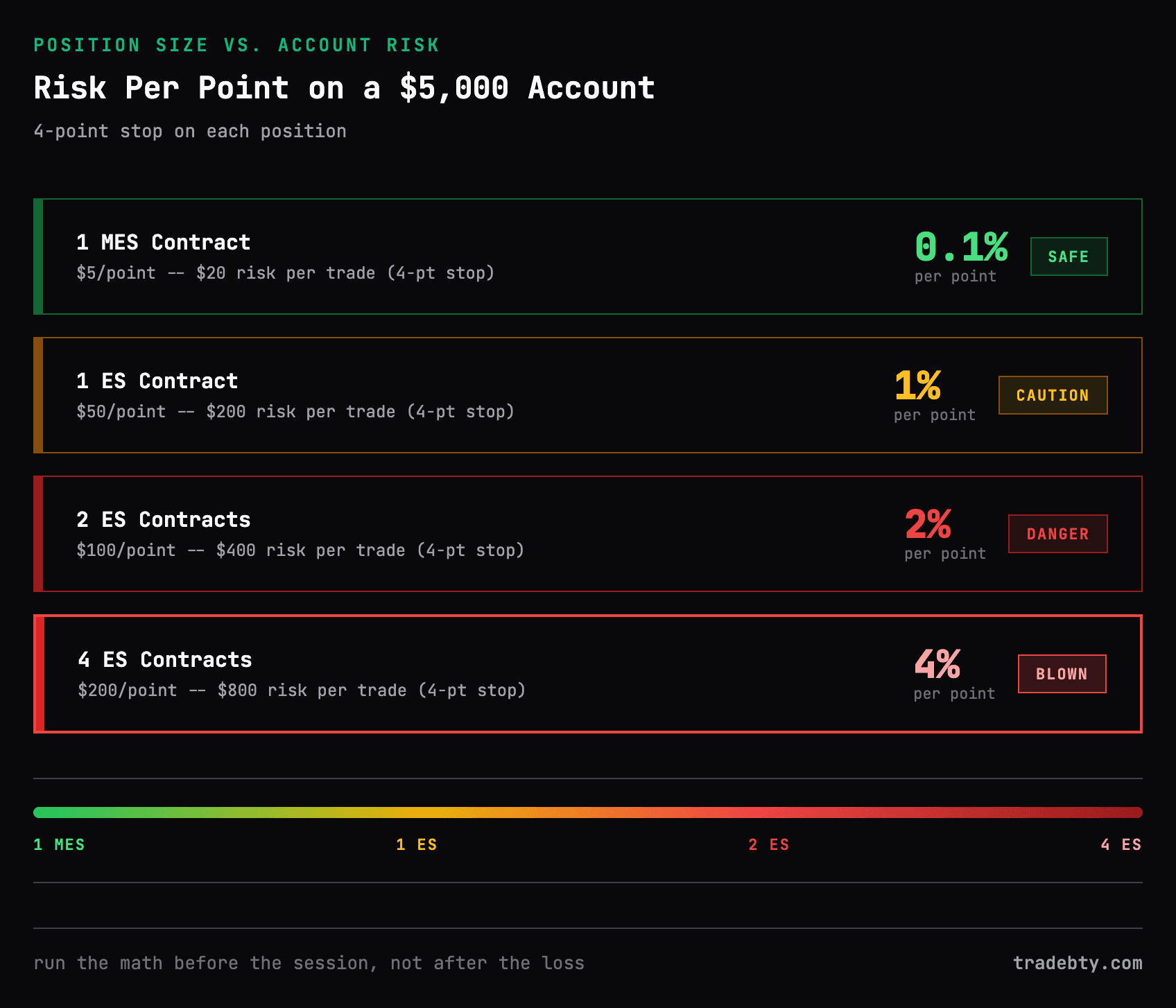
Small accounts make overtrading worse because the math is brutal and most traders never run it.
Let's say you have a $5,000 account trading ES futures ($50 per point, $12.50 per tick).
One contract, 4-point stop: $200 risk. That's 4% of your account on a single trade. Aggressive, but survivable.
Two contracts, same stop: $400 risk. Eight percent of your account. One loss and your morning is done.
Four contracts (because you "want to make real money"): $800 risk. Sixteen percent. One bad trade and you're in a psychological hole that takes days to climb out of.
Now add the second-order effect: after that $800 loss, you're at $4,200. To get back to $5,000, you need a 19% return. But you're trading the same size because "I need to make it back." That's the trap. Small accounts can't absorb the variance that oversized positions create.
MES ($5 per point) exists for exactly this reason. Two MES contracts with a 4-point stop: $40 risk. Under 1% of a $5,000 account. You can lose 10 of those and still be in the game. That's the difference between learning and bleeding.
The "$X Per Day" Mindset
Here's the thought that kills more small accounts than any bad setup: "I need to make $300 per day to make this worth my time."
The moment you set a daily income target, you've created pressure to trade. If it's 11:00 ET and you're flat, that target whispers: take something. If you're up $200, it says: one more trade to hit the number. If you're down $150, it screams: you need $450 now.
Income targets turn your trading session into a shift at a job. But trading isn't a job that pays hourly. Some days the market gives you nothing. Some days it gives you three clean setups before 10:00. Forcing the first type of day to look like the second is how you overtrade.
Replace the daily income target with a daily process target: "I will only take trades that match my active playbook rules. I will follow my position sizing rules. I will stop at my max loss limit."
The P&L follows the process. It doesn't work the other way around.
Concrete Rules That Actually Stop Overtrading
Max Trades Per Day
Set a hard cap. Not because more trades are inherently bad, but because a ceiling forces selectivity.
For a small account trading ES: 3-5 trades per session is a reasonable cap. That means you have to choose. You can't fire at every candle that moves. You wait for the setup that matches your rules.
Write it down. Track it. "Today I took 4 of my 5 allowed trades. 3 were playbook setups. 1 was not." That fourth trade is the one you review hardest.
Max Loss Per Day
This is non-negotiable for small accounts. A max daily loss of 2-3% of your account means you live to trade tomorrow.
$5,000 account: max daily loss of $150. That's three MES trades with 10-point stops. Or one ES trade with a 3-point stop. When you hit it, you close the platform. Not minimize -- close.
The max loss number should make you slightly uncomfortable. If it doesn't, it's too high to actually protect you.
Mandatory Size Reduction After Losses
After any losing trade, cut your size by 50% for the next entry. Not as punishment -- as protection. Your judgment after a loss is compromised. Smaller size means the next trade's outcome matters less emotionally, which means you're more likely to follow your rules.
If you take two consecutive losses, you're done for the session. This is a post-loss protocol, and it works better than discipline because it fires automatically.
The "Why Am I In This Trade?" Test
Before every entry, answer one question out loud: "What playbook rule does this trade follow?"
If you can't name the rule, you don't take the trade. This takes two seconds and eliminates 80% of overtrading. The trades you can't justify are the ones that blow up small accounts.
You Can't See Overtrading in Real-Time
This is the hard part. While you're overtrading, it feels productive. You're active. You're in the market. You're "learning." It's only in the review -- after the session, looking at your trade log -- that the pattern becomes obvious.
Sort your trades by whether they followed a playbook rule or not. Calculate the P&L for each group separately -- use the profit/loss calculator to see the real take-home after commissions, because fees compound fast when you're overtrading. Most traders find that their playbook trades are net positive and their non-playbook trades are a crater.
That crater is overtrading. And you can't see it until you measure it.
Track the time between entries. If you have three trades within a 10-minute window, that's almost certainly not three independent setups -- it's one loss followed by two attempts to erase it. The review template catches this pattern if you log entry times.
After 10 sessions of tracking, you'll know your number. "I overtrade on Mondays." "I overtrade after 11:00 ET." "I overtrade when I'm down more than $100." Those patterns turn into rules. Rules turn into a system that protects your account from you. For a broader look at why most day traders lose money and how structured reviews break the cycle, see how to stop losing money day trading.
Build the System Before You Need It
Overtrading a small account isn't a discipline problem. It's a structure problem. You need rules written down before the session starts, when you're calm and rational. Not at 10:15 ET when you're watching a position move against you.
The rules are simple: max trades, max loss, size reduction after losses, playbook-only entries. The hard part is tracking compliance -- which is why you review every day.
Your small account doesn't need more trades. It needs fewer trades, smaller size, and a system that catches you before you do damage.
TBTY structures your daily review around exactly this -- playbook compliance, position sizing, and pattern detection that surfaces your overtrading triggers. Use the position size calculator to run the math before the session starts. $9/mo founding rate, locked for life. Start here.
Keep Reading
- -Why Do I Keep Revenge Trading? -- the behavioral cousin of overtrading, and the post-loss protocol that breaks it.
- -MES Trading Mistakes Beginners Make -- small accounts on micros face the same traps at a different scale.
- -Morning Prep Before Looking at Charts -- the prep routine that limits you to planned trades only.
- -Best Time to Day Trade ES Futures -- mid-day chop is where most overtrading happens. Here's the session breakdown.
TBTY is an educational approach to structured trading review. Examples use ES futures for illustration only. Past patterns do not guarantee future results. Trading involves risk of loss. Always do your own analysis.
Want the complete framework?
This article is adapted from the TBTY framework. Get the free Quick Start Guide delivered immediately — two core ideas that fix most reviews.
Get the Free Quick Start Guide