You've been trading for six months. Maybe a year. You've learned three setups. You understand support and resistance. You can read a candle chart.
And you're still losing money.
Not catastrophically. You have a green week here and there. But the account balance trends one direction: down. Slowly, consistently, like a tire with a nail in it.
So you do what every struggling trader does. You look for a better setup. A different indicator. A new course. Maybe you switch from breakouts to mean reversion. Maybe you add volume profile. Maybe you change timeframes.
None of it works. Not because the setups are bad. Because the problem was never the setup.
Why Better Strategies Won't Save You
Here's the uncomfortable math. Across multiple studies of retail futures traders, 70-90% lose money. That's not because 70-90% of traders picked the wrong moving average crossover. It's because they're repeating the same behavioral mistakes -- and they don't have a system to catch them.
Think about it. You probably already know what your biggest problem is. Overtrading. Revenge trading. Moving stops. Sizing up after a win. Trading the 11:00 ET chop because you're bored.
You know. You just keep doing it. Because knowing and fixing are completely different skills, and the second one requires data.
A new strategy is a distraction. It feels like progress because you're learning something. But learning a fourth setup while you're still revenge trading after losses on the first three is like buying a faster car when you keep running red lights. Speed isn't your problem.
The Real Pattern: Unexamined Repetition
Day trading losses don't come from one big mistake. They accumulate from small, repeated mistakes that you never examine closely enough to fix.
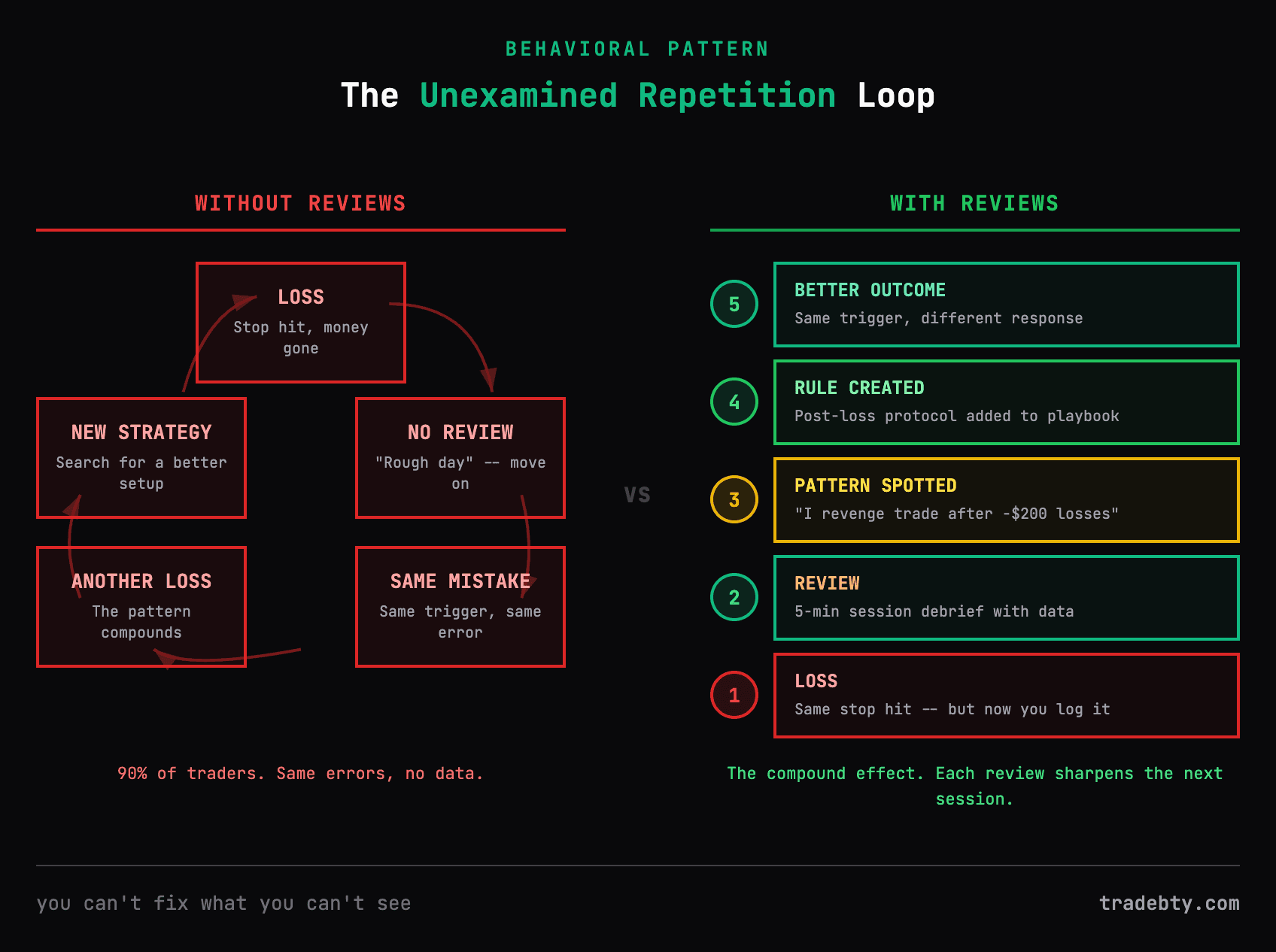
Here's what the pattern looks like from the inside:
Monday: You take a clean loss on a playbook setup. Fine. Then you take two revenge trades trying to get it back. Down $450 for the day.
Wednesday: Same thing happens. Different setup, same behavior. Down $380.
Friday: You have a strong morning. Up $250. Then you overtrade in the afternoon, give it all back, and finish down $50.
At the end of the week, you're down $830. But when someone asks what happened, you say "rough week" and start researching a new strategy for next week.
You never asked the real question: what percentage of my losses came from trades that followed my rules versus trades that didn't?
If you tracked it, you'd probably find that your playbook trades are close to breakeven or slightly positive. And your non-playbook trades -- the revenge entries, the boredom trades, the "I just had a feeling" trades -- account for 60-80% of your total losses.
That's not a strategy problem. That's a behavior problem. And behavior problems don't respond to new indicators.
How Structured Reviews Break the Cycle
A daily review does one thing that nothing else can: it makes your patterns visible.
Not your chart patterns. Your behavior patterns.
When you sit down after every session and answer specific questions -- what did I trade, what rule did it follow, what was my emotional state at entry, did I follow my stop -- you generate data about yourself. After 10 sessions, that data starts talking.
It tells you that you revenge trade after losses exceeding $200, not after smaller losses. It tells you that you overtrade between 11:00 and 12:00 ET. It tells you that your win rate on planned trades is 58% but your win rate on unplanned trades is 23%.
That's information you can act on. "Stop losing money" is useless advice. "Stop taking trades between 11:00-12:00 ET that don't match your three active rules" is a concrete, testable change.
The 9-section review template captures exactly this. Setup, rule, execution, emotional state, outcome. Each section takes 30 seconds. The whole review takes five minutes. What you get back is a dataset about your trading behavior that no course, no indicator, and no guru can give you.
What the Data Actually Shows You
Let me walk through two patterns that show up in almost every trader's review data.
Revenge Trading Costs
You already know revenge trading is bad. But do you know how much it costs you per month?
Pull your last 20 sessions. Flag every trade where you entered within 10 minutes of a loss, without a fresh setup that matched your rules. Add up the P&L on just those trades.
For most traders, the number is shocking. A trader losing $800/month might find that $500 of it comes from 4-5 revenge trades per week. Not from bad setups. Not from a losing edge. From a behavioral pattern that fires predictably and bleeds money.
Once you see the number, you can build a post-loss protocol: "After any loss exceeding $200, I close my platform for 15 minutes and reduce size by 50% on my next trade." Use the position size calculator to pre-calculate what that reduced size looks like. Write the rule in your playbook. Track compliance.
That single rule can be worth $400-600 per month in avoided losses. More than any setup will ever make you.
Overtrading Costs
Same exercise. Pull your last 20 sessions. For each session, count the number of trades that followed a playbook rule versus the ones that didn't. Calculate the P&L for each group. Run both through the profit/loss calculator to include commissions, because when you're overtrading, fees stack up fast.
Playbook trades: probably breakeven or slightly positive.
Non-playbook trades: almost certainly a crater.
The gap between those two numbers is what unstructured trading costs you. Every month. It's not bad luck. It's a measurable, fixable leak. But you can't see it until you separate the data.
The Compound Effect of Daily Reviews
One review doesn't change anything. Five reviews show a hint of a pattern. Twenty reviews show you exactly where you're bleeding.
Here's what happens over 30, 60, and 90 days of daily reviews.
Week 1-2 (Sessions 1-10): You start logging. It feels tedious. You don't see much yet. But you're building the habit and generating raw data. Most traders quit here because the payoff isn't immediate.
Week 3-4 (Sessions 11-20): Patterns emerge. You notice that you overtrade on Mondays. You notice that your morning prep days are more profitable than no-prep days. You start to see which of your playbook rules actually works.
Month 2 (Sessions 21-40): You build your first behavioral rule. Maybe it's a daily loss limit. Maybe it's a "no trades after 11:00 unless it's a Grade A setup" rule. You start tracking compliance. Your non-playbook trade count drops from 5 per week to 2.
Month 3 (Sessions 41-60): Compliance data accumulates. You know your win rate by setup, by time of day, by emotional state. You cut the rules that don't work. You tighten the ones that do. Your account starts trending in the right direction -- not because you found a better strategy, but because you stopped repeating the behaviors that were costing you money.
The traders who survive aren't the ones with the best setups. They're the ones who review every day, find their leaks, and build rules to plug them. It's not exciting. It's not a shortcut. But it works because it addresses the actual problem: you can't fix what you can't see.
Start With One Thing
You don't need to overhaul your entire trading process. Start with one question after every session: "Which of today's trades did not follow a rule in my playbook?"
Write down the answer. Do that for 10 sessions. Total up the P&L on just those unplanned trades.
That number is your cost of trading without structure. Once you see it, you can't unsee it. And that's when the real work starts.
TBTY structures this entire process -- daily review, playbook compliance, behavioral pattern detection, and the data that shows you where you're actually losing money. Use the position size calculator and profit/loss calculator to run your numbers before the session. $9/mo founding rate, locked for life. Start here.
Keep Reading
- -Why Do I Keep Revenge Trading? -- the behavioral loop behind your biggest unforced losses, and the post-loss protocol that breaks it.
- -Overtrading a Small Account: How to Actually Stop -- the concrete rules that stop you from trading outside your edge.
- -The 9-Section Trading Review Template -- the five-minute review that generates the data you need.
- -How to Build a Trading Playbook from Your Reviews -- turning review patterns into testable, trackable rules.
- -Morning Prep Before Looking at Charts -- the session prep that limits you to planned trades only.
TBTY is an educational approach to structured trading review. Examples use ES futures for illustration only. Past patterns do not guarantee future results. Trading involves risk of loss. Always do your own analysis.
Want the complete framework?
This article is adapted from the TBTY framework. Get the free Quick Start Guide delivered immediately — two core ideas that fix most reviews.
Get the Free Quick Start Guide