You take a clean loss. Good setup, reasonable stop, market didn't agree. Down $300. Fine.
Then something shifts. You're not reviewing the trade. You're scanning for the next entry. The stop-out is still burning, and the only thing that will put it out is making that $300 back. Right now.
So you take a trade you'd normally skip. Wider stop, no real setup, just a direction and a feeling. It doesn't work. Now you're down $800 and the session is ruined.
That's revenge trading. And if you've done it, you already know: "just don't do it" is about as useful as "just be patient."
What Revenge Trading Actually Is
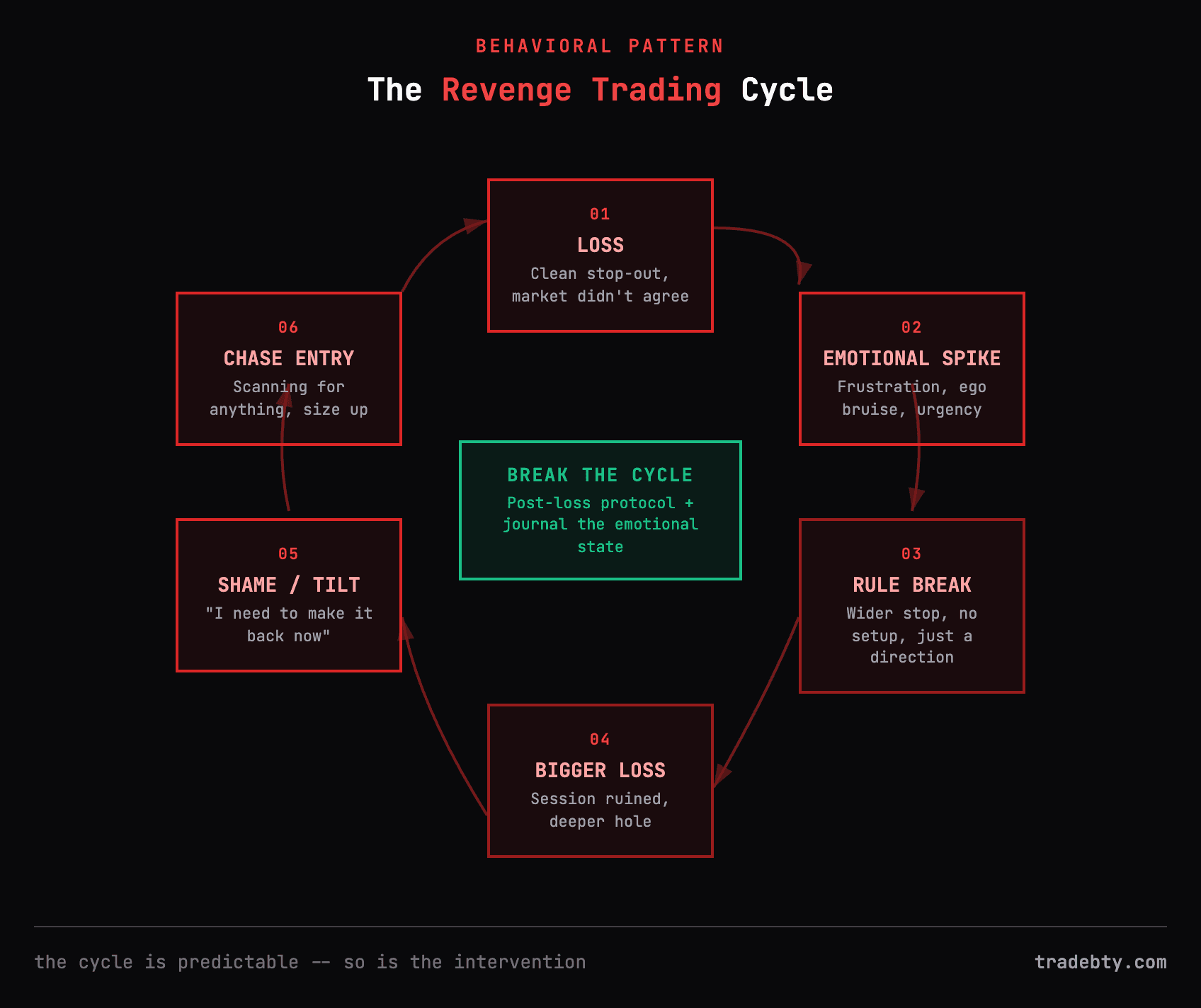
Revenge trading isn't just trading angry. It's a specific behavioral pattern with a predictable sequence:
- 1.A loss triggers an emotional spike -- frustration, ego bruise, urgency
- 2.The need to "get back to even" overrides your normal criteria
- 3.You enter a trade that breaks your own rules
- 4.That trade loses (or wins, which is worse, because it reinforces the behavior)
- 5.Repeat
The word "revenge" is misleading. You're not getting back at the market. You're trying to erase a feeling. The trade is an emotional painkiller, not a strategy.
Why Your Brain Does This
Three forces converge after a loss, and they're all working against you.
Loss aversion. Kahneman and Tversky's research showed that losing hurts roughly twice as much as winning feels good. A $300 loss doesn't feel like the opposite of a $300 win. It feels like something was taken from you. Your brain treats it as a threat, not a cost of business.
Sunk cost. You've already invested time, focus, and capital into this session. Walking away with a loss feels like wasting all of that. The irrational math says: one more trade could salvage the whole morning.
Ego protection. The loss challenges your identity as a competent trader. Taking another trade immediately is how your brain tries to restore that identity. It's not about the money -- it's about proving the loss was a fluke.
These three forces don't politely take turns. They hit simultaneously, in the 30 seconds after your stop gets filled. And they're strongest when the loss was on a good setup -- because then it feels unfair.
Why "Just Stop" Doesn't Work
Every article on revenge trading says the same thing: take a break, walk away, breathe.
That advice is correct and almost completely useless in the moment. Here's why.
Willpower is a resource. It depletes under stress. The moment after a loss is the exact moment you have the least willpower available. Telling a trader to "just walk away" after a painful stop-out is like telling someone to make a calm, rational decision while their hand is on a hot stove.
The solution isn't more discipline. It's a system that doesn't require discipline when you're compromised.
What Actually Works
1. A Post-Loss Protocol (Written Before You Need It)
The key word is "pre-committed." You write this rule on a calm Sunday, not during a drawdown.
Example: "After any loss greater than $250, I close my trading platform for 15 minutes. I do not scan for setups during this time. When I return, I reduce size by 50% for the next two trades."
This isn't a suggestion you make to yourself. It's a rule in your playbook, with the same status as an entry trigger or a stop-loss level.
The 15-minute gap matters more than you think. Research on decision-making under stress shows that the emotional hijack from a loss peaks in the first few minutes and fades significantly within 10-15 minutes. You're not waiting for zen. You're waiting for your prefrontal cortex to come back online.
2. Mechanical Size Reduction
After a loss, cut your size. Not because the market changed. Because your judgment did.
"If I take a loss exceeding $X, I reduce position size to Y contracts for the next Z trades." (Use the position size calculator to figure out what your reduced size looks like in contract terms before the session starts.)
This is a circuit breaker. The smaller size lowers the emotional stakes, which makes it easier to follow your actual criteria instead of chasing. And it limits the damage if you do slip.
Some traders use a daily loss limit instead: "If I'm down $500 for the day, I'm done." Same idea. The rule fires before your ego gets a vote.
3. Review the Revenge Trade Itself
Most traders review their planned trades. Almost nobody reviews the revenge trade. It gets buried in shame.
But the revenge trade is the most informative trade you'll take all week. Pull it up. Ask three questions:
- -What was the trigger? (The preceding loss? A specific dollar amount? A time of day?)
- -What rule did I break? (Entry criteria? Size limit? Session limit?)
- -What story was I telling myself? ("I need to get back to even." "This is a sure thing." "One more trade won't hurt.")
Write the answers down. After a few occurrences, a pattern emerges. Maybe it's always after the second loss, not the first. Maybe it's always in the 10:30-11:00 ET window when you're watching a position runner you missed. Once you see the trigger, you can build a rule around it.
4. Build a Playbook Rule
Once you've identified the pattern, formalize it. This is the same process described in turning observations into rules, applied to your own behavior instead of market structure.
Example playbook rule: "IF I take two consecutive losses in a session, THEN I reduce to 1 contract for my next trade and require a Grade A setup (opening range breakout with TICK confirmation above +400) before entering."
Now you have a conditional rule you can track. Log every time the condition fires. Log whether you followed it. After 10 occurrences, you have compliance data -- and that's where the real improvement happens.
5. Journal the Emotional State, Not Just the Trade Data
Your review captures the setup, the entry, the stop, the result. But it probably doesn't capture how you felt.
Add one field: emotional state at entry. Three words. "Calm, focused, prepared." Or: "Frustrated, rushing, chasing." That's it.
Over 20 sessions, filter by emotional state. You'll find that your win rate when calm is dramatically higher than your win rate when frustrated. It's obvious in hindsight. It's invisible without data.
This is the real insight about revenge trading: it's a data problem. You can't see the pattern until you track it. You can't break the cycle with willpower alone. You break it by making the cycle visible, measurable, and subject to rules.
The Pattern Is the Problem (and the Solution)
Revenge trading feels random. It feels like a character flaw. But it follows a pattern as predictable as any market setup:
Loss above threshold --> emotional spike --> rule-breaking entry --> worse outcome --> shame --> repeat.
Every step in that chain is a place to intervene. The post-loss protocol interrupts after step one. Size reduction limits the damage at step three. Reviewing the revenge trade exposes step five. The playbook rule replaces the whole chain with a conditional response.
You don't fix revenge trading by becoming a more disciplined person. You fix it by building a system that catches the pattern before it runs. Revenge trading is one of the biggest contributors to account bleed -- if you're trying to figure out how to stop losing money day trading, this is often the first leak to plug.
Voice-based review captures the emotional state in real time -- the frustration, the justification, the "I know I shouldn't but" -- and structures it into searchable data. That's how the pattern becomes visible. TBTY does this automatically. $9/mo founding rate, locked for life. Start here.
Keep Reading
- -Overtrading a Small Account: How to Actually Stop -- revenge trading's close cousin, and the rules that prevent both.
- -The 9-Section Trading Review Template -- the structured review that captures the emotional data revenge trading hides in.
- -Morning Prep Before Looking at Charts -- the State Gate that catches tilt before the session starts.
TBTY is an educational approach to structured trading review. Examples use ES futures for illustration only. Past patterns do not guarantee future results. Trading involves risk of loss. Always do your own analysis.
Want the complete framework?
This article is adapted from the TBTY framework. Get the free Quick Start Guide delivered immediately — two core ideas that fix most reviews.
Get the Free Quick Start Guide