TBTY vs Tradervue vs Edgewonk: Which Trading Journal Is Right for You?
I've used spreadsheets, Notion templates, Tradervue, and a Google Doc with 14 months of unreadable entries. Every trader eventually asks the same question: which journal is actually worth paying for?
This is a straight comparison of five tools -- Tradervue, Edgewonk, TradeZella, TradesViz, and TBTY. I'll cover what each does well, what it costs, and who should pick it. Some of these are better than TBTY for certain workflows. I'll say so when that's the case.
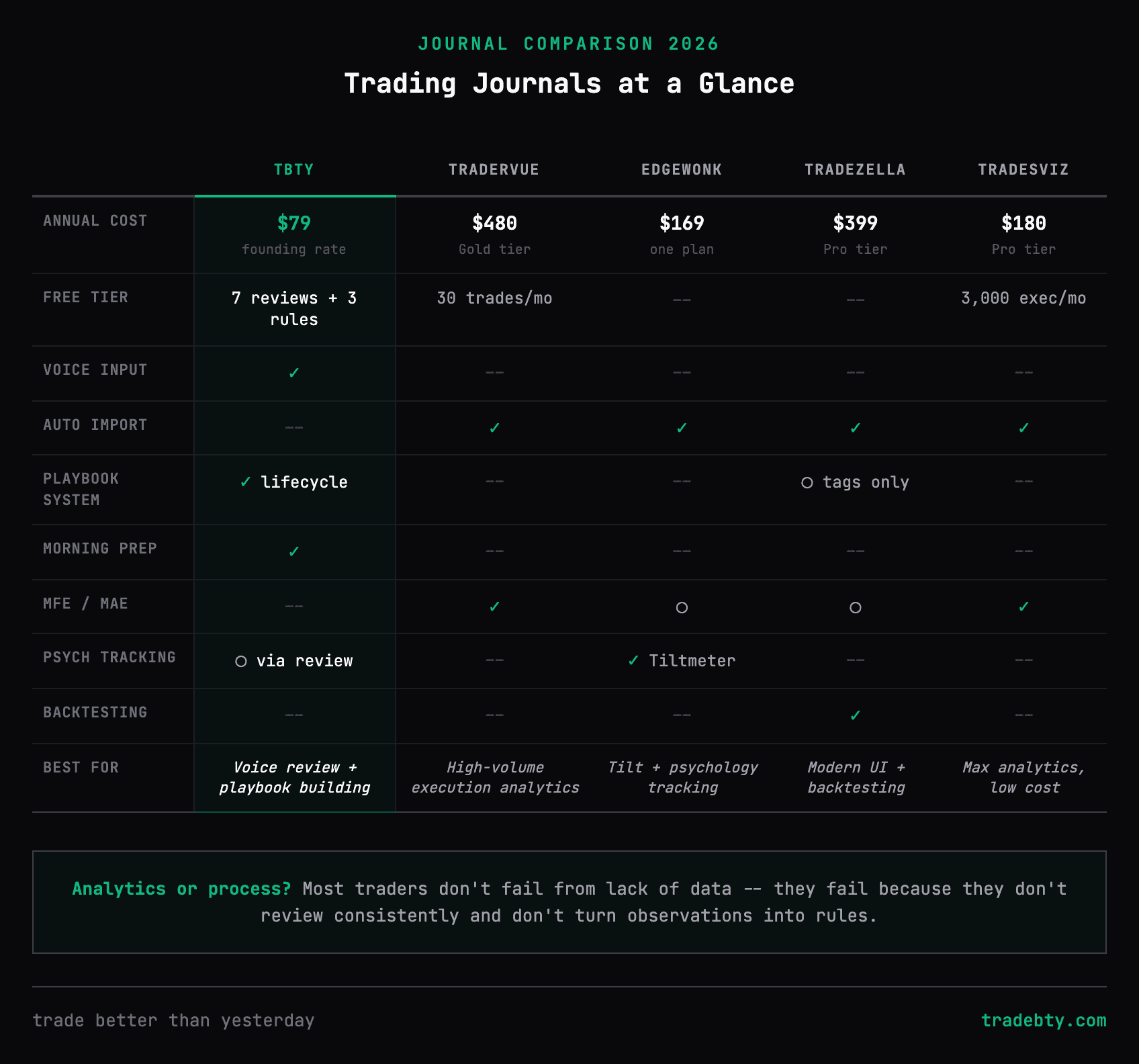
Quick Comparison
| Tradervue | Edgewonk | TradeZella | TradesViz | TBTY | |
|---|---|---|---|---|---|
| Price | Free / $29.95 / $49.95 mo | $169/yr | $29 / $49 mo | Free / $19.99 / $29.99 mo | Free / $9 mo |
| Free tier | 30 trades/mo | None | None | 3,000 executions/mo | 7 reviews + 3 rules |
| Best for | High-volume import + analytics | Psychology tracking | Slick UI + mentorship | Data-heavy analysis on a budget | Voice-first review + playbook building |
| Import | Broker auto-import | 200+ brokers | Broker auto-import | 200+ brokers | Manual via voice |
| Standout feature | Exit analysis + MFE/MAE | Tiltmeter (emotional tracking) | Backtesting + clean interface | 600+ stats, free tier depth | Voice capture, AI rule extraction |
Tradervue
Tradervue has been around since 2011, and it shows -- in both good and bad ways. The import pipeline is rock solid. Connect your broker, trades sync automatically, and you get detailed execution analytics without lifting a finger.
What it does well: If you take 20+ trades a day and need to analyze execution quality, Tradervue is hard to beat. The Gold plan's exit analysis tells you how much you left on the table relative to the best possible exit. MFE/MAE charts (maximum favorable and adverse excursion) show whether your stops are too tight or your targets too conservative. The sharing features and mentorship tools are useful if you work with a coach.
Where it falls short: The interface feels dated. Journaling is an afterthought -- you get a text box next to your trade data, but there's no structure guiding what you write. No playbook system. No morning prep workflow. It's an analytics platform with a journal bolted on, not a journal that builds your edge.
Pricing: Free tier limits you to 30 trades per month with minimal analysis. Silver runs $29.95/mo. Gold -- where the real features live -- is $49.95/mo ($479.52/yr if you pay annually). That's $600/yr for the full experience.
Pick Tradervue if: You're a high-frequency trader who needs execution analytics and broker auto-import above everything else. The data depth at the Gold tier is genuinely impressive. Worth it if you're analyzing hundreds of trades per month and care more about execution metrics than building a playbook.
Edgewonk
Edgewonk takes a different angle. Instead of focusing on trade imports and execution data, it leans hard into trading psychology. The Tiltmeter tracks your emotional state across trades and links those ratings to your P&L -- showing you exactly how much your mood costs you.
What it does well: The psychology tracking is unique. You rate your emotional state on each trade, and over time Edgewonk builds a profile of how tilt affects your results. The custom statistics engine lets you create your own metrics. Imports work with 200+ brokers. At $169/yr (~$14/mo), it's one of the more affordable paid options.
Where it falls short: It's purely analytical. There's no voice input, no morning prep, no daily review workflow. You enter data, and Edgewonk crunches numbers. If you don't already have a disciplined review habit, Edgewonk gives you powerful tools with no structure to use them in. Also, no monthly billing -- you pay $169 upfront for the year.
Pricing: $169/yr, period. No monthly plan. No free tier. There's a learning curve, but the per-month cost works out to roughly $14 -- reasonable for what you get.
Pick Edgewonk if: You already have a solid review routine and want deeper analytics, especially around psychology and tilt. The emotional tracking is something no other journal does as well. Good for swing traders and anyone who knows their biggest leak is mental, not mechanical.
TradeZella
TradeZella is the newest player and it shows in the UI -- clean, modern, and well-designed. They've focused on making the journaling experience feel less like homework. The backtesting feature lets you replay strategies against historical data.
What it does well: The interface is the best-looking of the bunch. Broker auto-import works smoothly. The mentorship features let coaches view student journals directly. Backtesting is a genuine differentiator -- most journals don't offer it at all. Playbook tracking exists, though it's more of a tagging system than a rule lifecycle.
Where it falls short: No free tier. The Basic plan at $29/mo gets you started, but Pro at $49/mo is where the real features unlock. That's the same price as Tradervue Gold. For a newer platform, that's a lot to ask. The journal itself is structured around trade entries rather than session reviews -- you're logging individual trades, not reviewing your decision-making across a full session.
Pricing: Basic at $29/mo ($24/mo annually). Pro at $49/mo ($33.25/mo annually). No free tier at all -- you're paying before you can evaluate.
Pick TradeZella if: You want a modern UI, broker auto-import, and backtesting in one package. Good for traders who are visual and want their journal to feel polished. The mentorship features make it a strong choice if you're working with a coach who uses TradeZella.
TradesViz
TradesViz is the value play. The free tier is absurdly generous -- 3,000 executions per month, 50+ visualizations, and no credit card required. If you just need a place to log and analyze trades without paying anything, this is it.
What it does well: Sheer analytical depth. 600+ statistics, 70+ interactive charts, custom dashboards. The Platinum tier adds AI-powered insights and a universal trading simulator. Supports every asset class. The free tier alone does more than some competitors' paid plans.
Where it falls short: The interface can feel overwhelming. With 600+ stats available, new traders might drown in data without knowing what matters. Like Tradervue, it's analytics-first. No review workflow, no playbook system, no voice input. You bring the discipline; TradesViz brings the data.
Pricing: Free tier (3,000 executions/mo). Pro at $19.99/mo ($14.99/mo annually). Platinum at $29.99/mo ($22.49/mo annually). The free-to-paid upgrade path is the smoothest of any journal.
Pick TradesViz if: You want maximum analytical power at the lowest price. The free tier is unbeatable for traders who just need data visualization. Good for data-oriented traders who already know what metrics matter to them.
TBTY
TBTY works differently from all of these. Instead of importing trades from your broker and analyzing execution data, it captures your review as a voice note after the close. You talk for 90 seconds, AI structures it into searchable fields, and conditional rules get extracted into your playbook automatically.
What it does well: The voice-first workflow removes the biggest barrier to consistent journaling -- actually doing it. Nine structured sections capture session context, key turning points, plan compliance, and rules for next time. The playbook system tracks IF/THEN rules through a lifecycle: Testing, Active, and Inactive. Your morning prep loads yesterday's key takeaway and today's relevant rules automatically.
Where it falls short: No broker auto-import. If you need execution analytics, MFE/MAE charts, or exit analysis on individual trades, TBTY doesn't do that. It's a review and playbook tool, not a trade analytics platform. It focuses on ES futures workflows specifically -- not a general multi-asset journal.
Pricing: Free tier gives you 7 reviews and 3 playbook rules. Paid plan is $9/mo founding rate, locked for life. ($79/yr annual.) After the first 100 users, the price goes to $19/mo for new subscribers.
Pick TBTY if: You struggle with consistency. If you've tried journaling before and stopped because it felt like homework, the voice workflow changes that. Good for futures traders who care more about improving their decision-making process than analyzing individual trade executions. The playbook lifecycle -- where rules get promoted, demoted, or retired based on data -- is something the analytics-focused journals don't offer.
The Real Question: Analytics or Process?
These tools split into two camps.
Analytics-first (Tradervue, TradesViz, TradeZella): Import trades automatically, get detailed execution data, build your own insights from the numbers. Great if you're disciplined enough to review consistently on your own and know which metrics matter.
Process-first (TBTY, partly Edgewonk): Structure the review itself. Guide you through what to capture, build rules from your observations, and create a feedback loop between today's review and tomorrow's prep.
Most traders don't fail because they lack data. They fail because they don't review consistently, don't turn observations into rules, and don't track whether those rules actually work. If that sounds familiar, a process-first tool will move the needle more than another dashboard.
If you already review every day and need deeper trade-level analytics, Tradervue Gold or TradesViz Platinum will serve you better than TBTY. That's not a knock -- they solve a different problem.
Cost Breakdown (Annual)
For the full-featured tier of each:
- -TBTY: $79/yr (founding annual) or $108/yr monthly
- -Edgewonk: $169/yr
- -TradesViz Pro: $179.88/yr
- -TradeZella Basic: $288/yr
- -Tradervue Gold: $479.52/yr (annual) or $599.40/yr monthly
- -TradeZella Pro: $399/yr
The price difference is real. TBTY at $79/yr versus Tradervue Gold at $480/yr is $400 in your pocket. But if you need Tradervue's execution analytics, TBTY isn't a substitute -- they do different things.
Bottom Line
There's no single best journal. There's the best journal for how you actually trade and what you actually need.
Need execution analytics and broker imports? Tradervue or TradesViz.
Want psychology tracking and emotional tilt data? Edgewonk.
Want the best-looking interface with backtesting? TradeZella.
Want maximum free features? TradesViz.
Want a voice-first review that builds your playbook? TBTY.
Pick the one that matches the problem you actually have. The best journal is the one you'll use tomorrow morning.
TBTY also offers free tools to get started: a position size calculator, risk/reward calculator, and profit/loss calculator -- no login required. The founding rate is $9/mo, locked for life, and the free tier lets you try the full review workflow with 7 sessions and 3 playbook rules. No credit card required. Try it here.
Keep Reading
- -TBTY vs TradeZella: Why I Switched -- a deeper first-person comparison focused on the daily workflow difference.
- -The 9-Section Trading Review Template -- what the TBTY review actually looks like, section by section.
- -How to Build a Trading Playbook from Your Reviews -- the playbook lifecycle that analytics-first journals don't offer.
TBTY is an educational approach to structured trading review. Competitor pricing was verified in February 2026 and may change. Examples use ES futures for illustration only. Past patterns do not guarantee future results. Trading involves risk of loss. Always do your own analysis.
Want the complete framework?
This article is adapted from the TBTY framework. Get the free Quick Start Guide delivered immediately — two core ideas that fix most reviews.
Get the Free Quick Start Guide