I used TradeZella for five months. I wanted to like it. The interface is clean, the analytics are solid, and the trade replay feature is genuinely impressive. But I stopped using it.
Not because it's a bad product. Because I stopped journaling.
That's the part nobody talks about in trading journal reviews. The best features in the world don't matter if the tool sits unused after the first three weeks. And TradeZella, for all its polish, turned my post-session review into homework I kept putting off.
So I built something different. This is an honest comparison from someone who actually paid for both.
What TradeZella Does Well
Credit where it's due.
The UI is the best in the business. Clean, modern, well-designed. Everything loads fast. The dashboard gives you a clear snapshot of your performance without digging through menus. If you care about how your tools look -- and you should, because you'll stare at them every day -- TradeZella wins.
Broker auto-import works. Connect your broker, trades sync in. 400+ broker integrations. No manual entry for the trade data itself. That's table stakes for an analytics platform, but TradeZella does it smoothly.
Trade replay is a real differentiator. Replaying trades tick by tick with Level 2 data and your executions plotted on the chart -- that's powerful. I learned things about my entries watching replays that I missed in real time. If execution analysis is your priority, this feature alone might justify the price.
Backtesting exists. Most journals don't offer it. TradeZella does, and it's unlimited on every plan. Good for validating a setup idea before risking capital.
Mentorship features are solid. If you work with a coach, TradeZella's Spaces feature lets them view your journal directly. Useful for prop firm evaluations too.
Where It Fell Short (For Me)
None of this is a knock on TradeZella as a product. It's a knock on how it fit my actual workflow as an ES futures day trader.
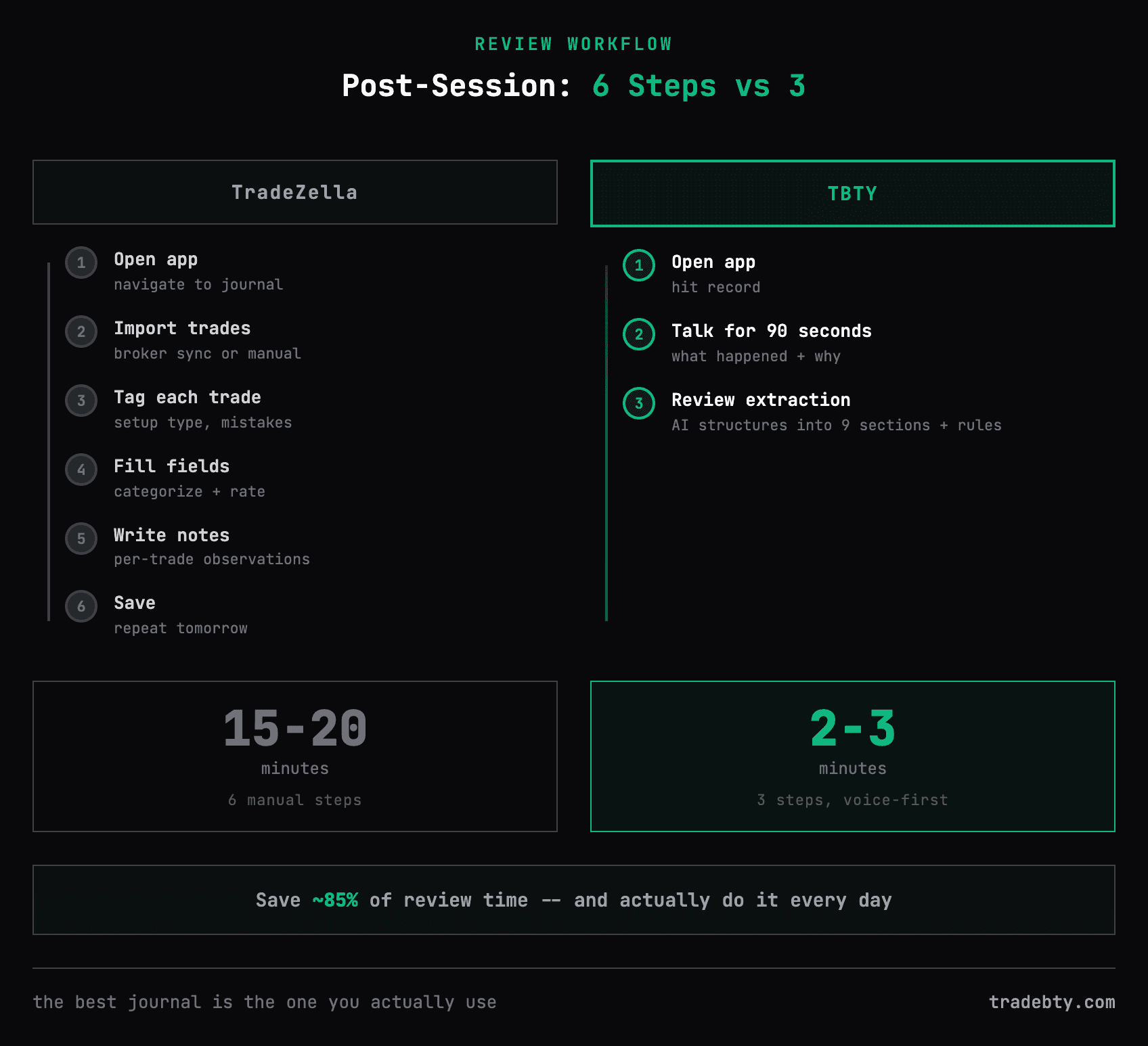
The journal part felt like a chore. TradeZella is structured around individual trade entries. Import trades, tag them, add notes, categorize setups and mistakes. Every trade. Every day. After a 4-hour session with 6-8 trades, the last thing I wanted was 20 minutes of clicking and typing to tag each one. By week three, I was skipping days. By month two, I was logging trades but not writing any notes. By month four, I opened the app maybe twice a week.
The irony: the data was all there, but I wasn't doing anything with it. Import without reflection is just record-keeping.
Data without structure doesn't create insights. TradeZella gives you 50+ reports and impressive charts. Win rate by day of week. Average hold time by setup. Profit by time of day. But knowing my Tuesday win rate was 12% lower than Friday didn't tell me why, or what to do about it. The numbers described my trading. They didn't improve it.
I needed a tool that asked me the right questions after the close. "What was your key turning point today?" "Did you follow the execution script?" "What rule do you want to test tomorrow?" TradeZella doesn't ask those questions. It waits for you to type.
No review workflow. There's no morning prep. No structured daily review. No "here's what you said yesterday, and here are the rules that apply to today's conditions." You build trading plans in the notebook feature, but they're static documents. They don't connect to your daily process.
No playbook lifecycle. TradeZella has playbooks, but they're closer to a tagging system. You can create playbook entries and tag trades. What's missing is the lifecycle: promoting a rule from Testing to Active after 20 occurrences, retiring rules that stop working, tracking whether a rule is actually making you money over time. A playbook that doesn't evolve is just a list.
The price adds up. Basic is $29/mo for one account, 1GB storage, and 3 playbooks. Premium is $49/mo for unlimited everything. No free tier. Annual pricing brings it to $24-33/mo, but you're still paying $288-399/yr before you can decide if it fits your workflow.
What I Needed Instead
After quitting TradeZella, I kept a voice memo habit for a few weeks. Hit record after the close, talk for 90 seconds about what happened. It stuck in a way that typing never did.
That was the seed. Speaking is faster than typing. And the details are sharper right after the close -- the ADD reading on that breakout, whether the OR held for 2 minutes or 3, the exact moment you knew the thesis was wrong. Those details evaporate by the time you sit down to type.
TBTY grew out of that voice memo habit. Talk after the close, AI structures it into nine sections (market context, key turning points, plan compliance, rules for next time), and conditional rules get extracted into a playbook automatically. Morning prep loads yesterday's takeaway and today's relevant rules.
The core difference: TradeZella is built around trade-level analytics. TBTY is built around session-level review and playbook building. Both are valid approaches. They solve different problems.
Side-by-Side
| TradeZella | TBTY | |
|---|---|---|
| Price | $29-49/mo ($288-399/yr) | Free / $9/mo ($79/yr) |
| Free tier | None | 7 reviews + 3 rules |
| Review time | 15-20 min (tagging + notes) | 90 seconds (voice) |
| Trade import | 400+ broker auto-import | Manual via voice |
| Best analytics | Trade-level execution data, MFE/MAE, replay | Session-level patterns, rule win rates |
| Playbook | Tagging system (3 on Basic) | Lifecycle: Testing > Active > Inactive |
| Morning prep | None built-in | Auto-loads yesterday + today's rules |
| Trade replay | Yes (with Level 2 on Premium) | No |
| Backtesting | Yes (unlimited) | No |
| Mentor mode | Yes (Spaces) | No |
| Voice input | No | Core workflow |
| Best for | Execution analysis + prop firms | Session review + playbook building |
Who Should Use TradeZella
TradeZella is genuinely good for a specific trader.
Pick TradeZella if you take 20+ trades a day across multiple instruments, need execution analytics, and already have the discipline to journal consistently. The trade replay alone is worth the price if you're actively studying your entries and exits. It's also strong if you work with a mentor who uses TradeZella, or if you're in a prop firm that wants to see structured trade data.
If your problem is "I need better analytics on my executions," TradeZella solves it.
Who Should Use TBTY
Pick TBTY if your problem is consistency. If you've tried journaling and stopped because it felt like homework. If you have drawers full of data but no playbook. If you know your biggest edge leak is process, not execution.
The voice workflow changes the equation. Talking for 90 seconds after the close is a lower bar than opening an app, tagging 8 trades, and writing notes on each one. And the playbook lifecycle -- where rules get tested, promoted, and retired based on actual data -- is what turns observations into edge.
TBTY doesn't do what TradeZella does with trade-level analytics. If you need MFE/MAE charts, execution replays, or broker auto-import, TBTY isn't a substitute. They solve different problems.
What I Miss
The trade replay. I genuinely miss it. Watching my entries unfold tick by tick taught me things about my timing that I couldn't see in a static chart. If TradeZella ever offers a replay-only tier at a lower price, I'd probably subscribe alongside TBTY.
The UI polish, too. TradeZella looks better than anything else in the space. That matters for a tool you're supposed to open every day.
What I Don't Miss
The 20-minute post-session tagging ritual. The guilt of seeing an empty journal for the third day in a row. The feeling of having mountains of data and no idea what to do with it.
The best journal is the one you actually use. I stopped using TradeZella. I haven't missed a day with TBTY since I started the voice workflow.
That's not because TBTY is objectively better. It's because it fits how I actually work after the close: tired, want to decompress, willing to talk but not willing to type.
TBTY also offers free tools you can use right now: a position size calculator, risk/reward calculator, and profit/loss calculator. The founding rate is $9/mo, locked for life. The free tier lets you try the full review workflow with 7 sessions and 3 playbook rules. No credit card required. Try it here.
Keep Reading
- -TBTY vs Tradervue vs Edgewonk: Full Comparison -- a broader comparison covering five trading journals.
- -The 9-Section Trading Review Template -- what TBTY's voice review actually captures, section by section.
- -Why "Be Patient" Is the Worst Trading Advice -- the problem with vague journal notes that TradeZella can't fix either.
TBTY is an educational approach to structured trading review. TradeZella pricing was verified in February 2026 and may change. Examples use ES futures for illustration only. Past patterns do not guarantee future results. Trading involves risk of loss. Always do your own analysis.
Want the complete framework?
This article is adapted from the TBTY framework. Get the free Quick Start Guide delivered immediately — two core ideas that fix most reviews.
Get the Free Quick Start Guide