ES Futures Day Trading for Beginners: What the Courses Don't Teach You
You finished the course. You can identify a bull flag, an opening range breakout, a VWAP reversion. You understand tick charts. You know what TICK and ADD are. You passed the sim evaluation.
Now you go live. And within two weeks, you're down $1,200 and wondering what you missed.
You didn't miss a setup. You missed everything around the setup -- the part that actually determines whether you survive long enough to become profitable. And your course didn't cover it, because risk management and review processes don't sell as well as "my proprietary 3-tap setup."
Here's what matters first. None of it is glamorous.
The Gap Between Knowing Setups and Making Money
Setups are maybe 20% of profitable trading. They're the part that gets taught because they're visual, concrete, and easy to package into a curriculum. "Wait for price to break above the opening range high with TICK above +400. Enter on the first pullback. Stop below the range."
That's a valid setup. It's also completely insufficient.
What the course didn't cover:
- -How many contracts should you trade relative to your account size?
- -What happens to your position sizing after two consecutive losses?
- -How do you know if this setup actually works for you, not just for the instructor?
- -What do you do at 10:45 ET when nothing is setting up and you're bored?
- -How do you track whether you're following your own rules or just winging it?
These aren't advanced topics. They're survival topics. And they separate the 10% who make it from the 90% who blow out their accounts and blame the market.
What Actually Matters First
1. Risk Management Math (Before Everything Else)
Before you take a single live trade, you need to know your numbers. Not approximately. Exactly.
Account size: Let's say $10,000.
Risk per trade: 1-2% of your account. That's $100-$200.
ES contract: $50 per point, $12.50 per tick. A 4-point stop on 1 ES contract = $200 risk. That's 2% of your account. Acceptable, but tight.
MES contract: $5 per point, $1.25 per tick. Same 4-point stop = $20 risk. That's 0.2% of your account. Room to make mistakes.
Run these numbers with a position size calculator before every session. Not in your head -- actually calculate it. The number of beginners who trade 2 ES contracts on a $10,000 account because "the instructor uses 2 contracts" is staggering. That's 4% risk per trade. Two losses and you're down 8% before lunch.
If your account is under $10,000, start on MES. Not because you're not ready -- because the math doesn't work on ES at that size. A 4-point stop on 1 ES contract risks 4% of a $5,000 account. That's not conservative. That's reckless.
2. The Review Habit (More Important Than the Setup)
Your course spent 40 hours on entries and exits. How much time did it spend on reviewing your trades?
Probably zero. And that's the single biggest gap in trading education.
A daily review takes five minutes. After every session, you answer: What did I trade? What rule did it follow? Did I follow my stop? What was my emotional state at entry? What would I do differently?
That's it. Five minutes. But after 20 sessions, you have a dataset that tells you things no course can:
- -Your win rate by setup type
- -Your average win versus average loss
- -Which times of day you perform best
- -Whether you follow your rules or break them under pressure
- -Your real edge -- or the lack of one
Without this data, you're guessing. You think your breakout setup works because you remember the winners. You forget the three times it chopped you out. The review captures all of it, not just the highlights.
3. Building Your Personal Playbook
Your course gave you setups. Now you need to turn them into rules you own.
A trading playbook isn't a list of setups from a course. It's a set of specific, conditional rules that you've tested, tracked, and validated against your own data.
Course setup: "Buy the opening range breakout."
Your playbook rule: "IF ES gaps up less than 0.5%, AND the opening range forms within the first 15 minutes, AND price breaks above the range high with TICK above +400, THEN enter long with a stop 1 point below the range low. Target: 1.5x the range width."
The difference? Specificity. The course setup is a concept. The playbook rule is testable. You can log every time it fires, track the outcome, and calculate whether it actually works for you. Use a risk/reward calculator to check your R:R math before you add the rule.
Start with one rule. Trade only that rule for two weeks. Log every occurrence. After 15-20 occurrences, you have a real sample size. Win rate above 50% with at least 1:1 R:R? Keep it. Below 40%? Modify or cut it. Add a second rule only after the first one is validated.
The 30-Day Starter Plan
This is what I'd tell any beginner who just finished a course and is going live on ES futures. Four weeks. One focus per week. No shortcuts.
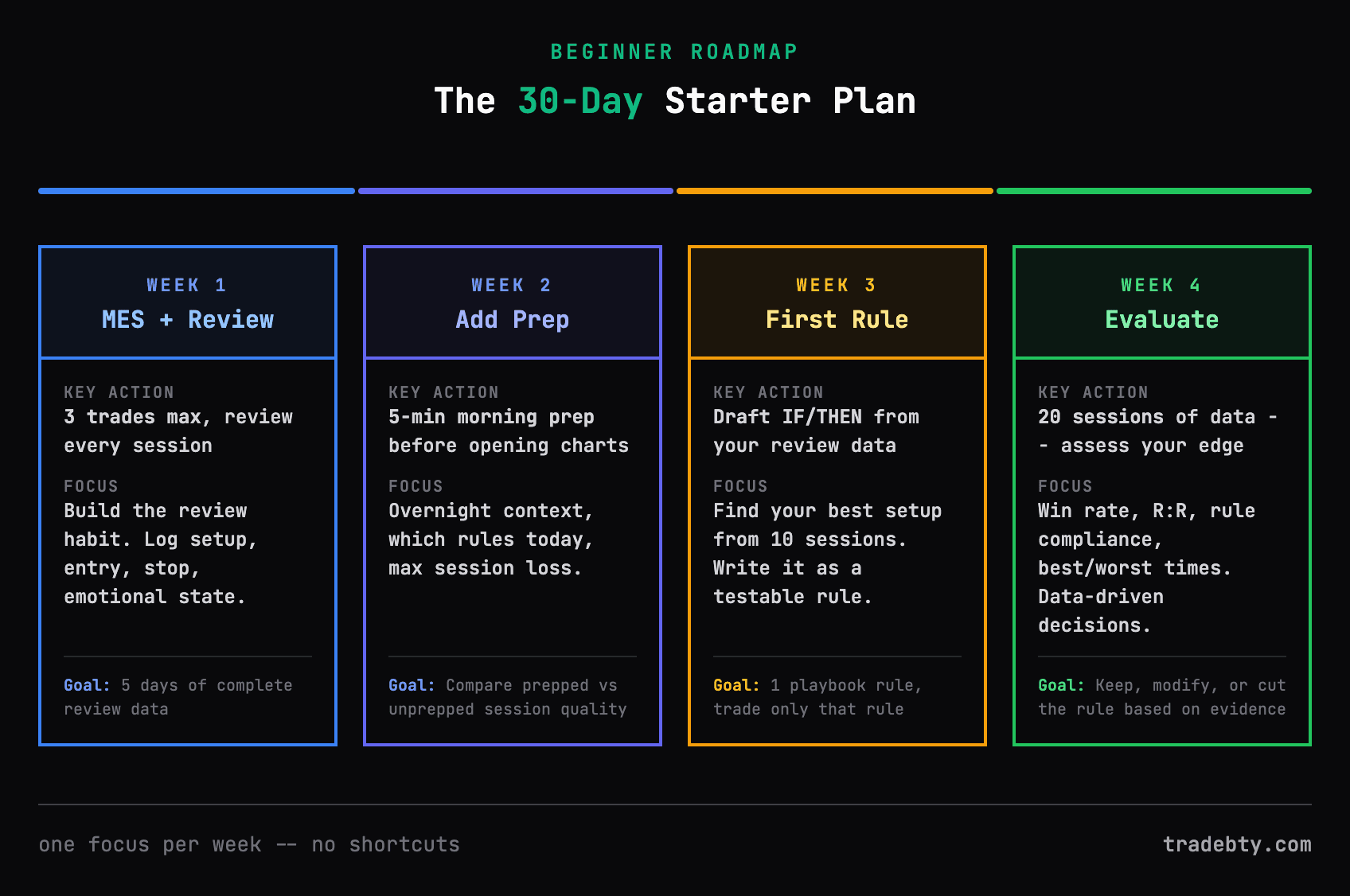
Week 1: MES + Review Only
Trade MES exclusively. One or two contracts. Maximum 3 trades per day.
Your only goal this week: take trades and review them. Not to be profitable. Not to hit a P&L target. Just to build the habit of structured review.
After every session, fill out the review template. Log the setup, the entry, the stop, the target, the result, and your emotional state. It takes five minutes.
At the end of the week, you have 5 days of data. Look at it. Which trades followed a rule? Which didn't? Where did you lose the most? You're starting to see your own patterns.
Week 2: Add Morning Prep
Keep trading MES, same size limits. Now add a 5-minute morning prep before you open any chart.
The prep answers three questions: What's the overnight context? Which rules am I trading today? What's my max loss for the session?
This sounds trivial. It's not. The morning prep turns your session from "let's see what happens" into "I have a plan and I'm executing it." The difference in trade quality between prepped and unprepped sessions will show up in your review data within a week.
Week 3: Draft Your First Playbook Rule
By now you have 10+ reviewed sessions. Pull up your data. Find the setup that appeared most frequently and performed best.
Write it as a specific, conditional rule. Not "buy breakouts." Something like: "IF the opening range is less than 5 points AND price breaks above with at least +300 TICK AND time is before 10:30 ET, THEN enter long 1 MES, stop 1 point below the range, target 1.5x range width."
Put it in your playbook. From this point forward, that rule is the only thing you trade. Everything else is an observation you log but don't act on.
Week 4: Evaluate
You now have 20 sessions of data. Enough to ask real questions.
- -What's your win rate on your playbook rule?
- -What's your average R:R?
- -How many non-playbook trades did you take, and what did they cost you?
- -Did you follow your stops?
- -What time of day are your best and worst trades?
If your playbook rule is positive after 20 occurrences, you have the beginning of an edge. If it's not, you have specific data about what to adjust -- which is infinitely more useful than guessing.
This is also when you decide whether to stay on MES or graduate to 1 ES contract. The MES graduation criteria are clear: consistent execution for 20+ sessions, defined rules with tracked data, and your max daily loss not hit three sessions in a row.
Common Beginner Mistakes the Courses Don't Mention
Trading too many setups at once. Your course taught you six setups. You're trying to trade all six in your first week. Pick one. Master it. Add the second one after 20 occurrences of the first.
No daily loss limit. Without a hard stop for the day, one bad trade turns into four. Set a max daily loss -- 2% of your account -- and close the platform when you hit it. Not minimize. Close.
Skipping the review on green days. You made $300. Great. You still need to review. Maybe that $300 came from one clean trade and two sloppy trades that happened to go your way. The review catches the sloppiness before it costs you on a day when luck doesn't bail you out.
Copying someone else's exact trades. The instructor trades 5 ES contracts with a $500,000 account. You're trading 1 MES with $5,000. The risk profile, the psychology, and the margin for error are completely different. Use their framework. Build your own rules.
Ignoring commissions and fees. An MES round-trip costs about $1.25 per contract. If you're taking 15 trades a day on 3 contracts, that's $56 in commissions alone. Run your real numbers through the risk/reward calculator with fees included.
No [morning prep](/blog/morning-prep-before-looking-at-charts). You sit down, open the chart, and start scanning for entries. You're reacting instead of executing. Five minutes of prep before the session changes everything.
The Course Is the Beginning, Not the End
Courses teach you the vocabulary of trading: setups, entries, exits, chart patterns. That's necessary. It's also wildly insufficient.
The part that determines whether you'll survive -- risk management, daily review, playbook development, behavioral rules -- is the work you do after the course ends. It's less exciting. It doesn't fit into a weekend bootcamp. But it's the actual skill of trading.
Start with math. Build the review habit. Draft one rule. Track it. Iterate based on data, not feelings. That's the path. Everything else is decoration.
TBTY structures this entire beginner progression -- daily review, playbook building, compliance tracking, and the data that shows you whether your rules actually work. Use the position size calculator and risk/reward calculator to run your math before you trade. $9/mo founding rate, locked for life. Start here.
Keep Reading
- -MES Trading Mistakes Beginners Make -- the seven mistakes that turn micros into an expensive lesson.
- -How to Build a Trading Playbook from Your Reviews -- the system for turning observations into testable rules.
- -Morning Prep Before Looking at Charts -- the five-minute routine that separates reactive trading from planned execution.
- -Overtrading a Small Account: How to Actually Stop -- the concrete rules that protect small accounts from behavioral leaks.
- -The 9-Section Trading Review Template -- the template that captures the data courses never teach you to track.
- -Free Trading Journal Template -- the 5-section template that captures what spreadsheets miss.
- -Best Time to Day Trade ES Futures -- the session-by-session breakdown courses skip.
TBTY is an educational approach to structured trading review. Examples use ES futures for illustration only. Past patterns do not guarantee future results. Trading involves risk of loss. Always do your own analysis.
Want the complete framework?
This article is adapted from the TBTY framework. Get the free Quick Start Guide delivered immediately — two core ideas that fix most reviews.
Get the Free Quick Start Guide