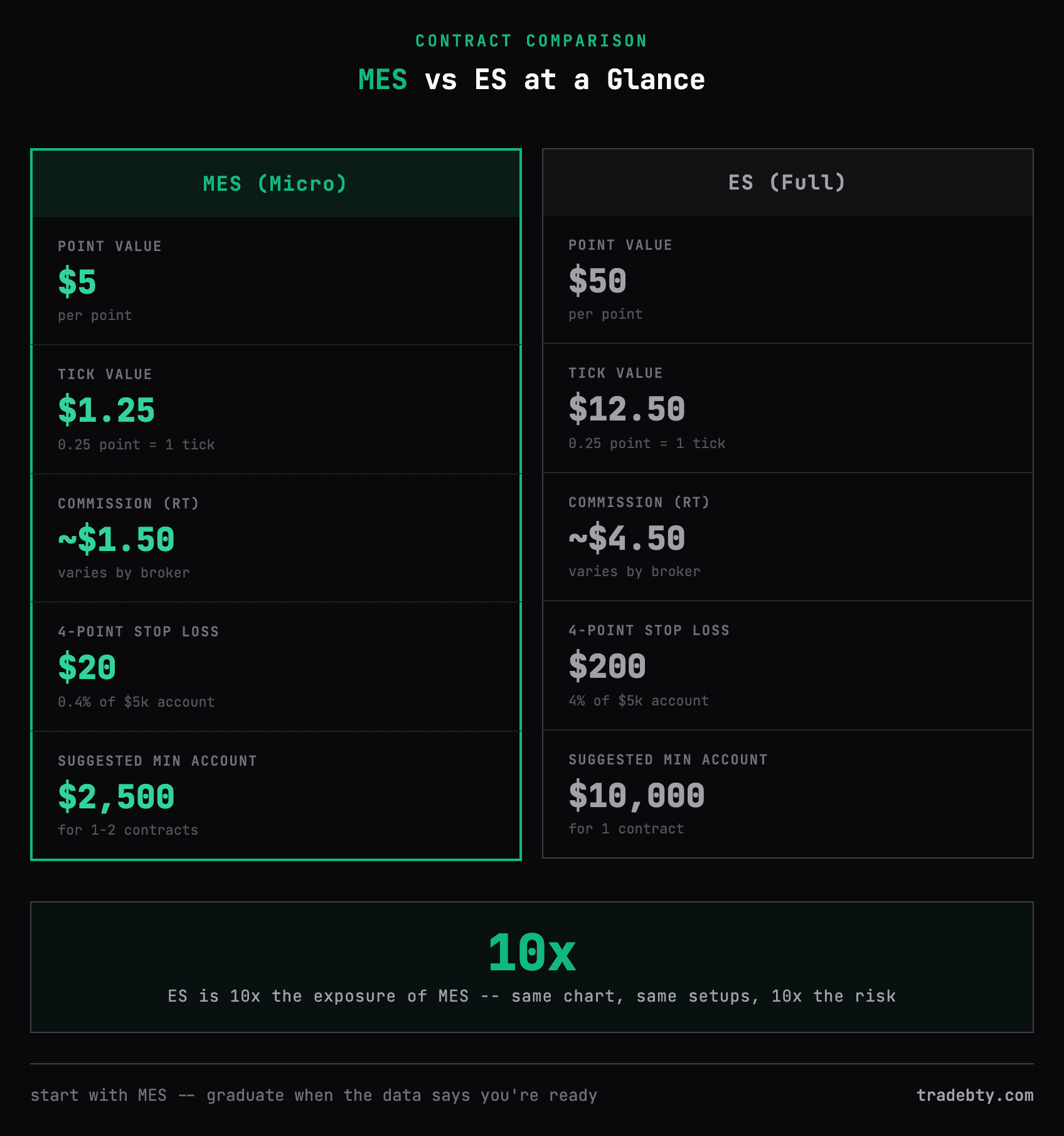
The Micro E-mini S&P 500 (MES) is $5 per point. One-tenth the size of ES. A 4-point stop costs you $20 instead of $200. For a trader learning to day trade futures, it's the most forgiving place to start.
That's the pitch. And it's accurate. MES genuinely is the best entry point for new futures traders. The problem is what happens next.
Most beginners treat MES like a demo account with real money. They oversize because the dollar amounts look small. They skip reviews because a $15 loss doesn't feel worth analyzing. They stay on MES for a year past the point where they should have graduated. And they accumulate the exact same bad habits they'd build on ES -- just in smaller increments.
Here are the seven mistakes I see most often, and what to do about each one.
1. Oversizing Because "It's Just Micros"
This is the most common and the most dangerous.
A trader with a $5,000 account loads 20 MES contracts because "each one is only $5 a point -- it's basically nothing." Twenty MES contracts equals 2 ES contracts. A 4-point move against you is $400. That's 8% of your account on a single trade.
The math is identical. Twenty MES at $5/point is the same exposure as 2 ES at $50/point. The only difference is the number on the screen makes it feel smaller.
Run the actual numbers before every session. Use a position size calculator and input your account size, stop distance, and the number of MES contracts. If the dollar risk per trade exceeds 2% of your account, you're oversized. Period. It doesn't matter that they're micros.
A good starting point: 1-2 MES contracts with a defined stop. With a $3,000 account and a 4-point stop, 2 MES contracts risk $40 -- about 1.3% of your account. That's a position size that lets you take 20 consecutive losses before losing a quarter of your capital. That's room to learn.
2. Ignoring Commission Costs
MES commissions are roughly $1.00-$1.50 per contract round-trip depending on your broker. That sounds trivial until you do the volume math.
If you trade 10 MES contracts per day at $1.25 round-trip, that's $12.50 in commissions daily. Over 20 trading days: $250 per month. On a $3,000 account, commissions alone eat 8% of your capital annually. Run your actual numbers through the profit/loss calculator to see what your real take-home looks like after fees.
Now consider that each MES tick is $1.25. Your round-trip commission on a single contract is equivalent to winning one tick. You start every trade one tick in the hole.
At high volumes -- say 20-30 contracts per day, which beginners often hit because they're "just practicing" -- commissions become your largest expense. Check your monthly statement. If commissions are more than 20% of your gross P&L, you're overtrading relative to your size.
3. Treating It as Practice Instead of Real Trading
"I'll trade MES until I'm ready for ES." Fine. But what does "ready" mean?
If you're trading MES without a playbook, without a daily review, without defined rules -- you're not practicing. You're just losing smaller amounts of money without learning anything transferable.
The habits you build on MES are the habits you'll bring to ES. If you revenge trade on MES, you'll revenge trade on ES. If you skip your evening review because "it was only a $30 loss," you'll skip your review on ES when it's a $300 loss. The contract size changes. The behavior doesn't.
Treat every MES session like it's ES. Full morning prep. Defined rules. Max daily loss. Post-session review. If you can't do this consistently on MES, you're not ready for ES -- and more importantly, you're not learning anything by staying.
4. Ignoring the Spread
ES typically trades with a 0.25-point spread (one tick) during regular trading hours. The book is deep and fills are fast.
MES spreads can widen to 0.50 or even 0.75 points during slower sessions -- early morning, late afternoon, around economic releases. On a $5/point contract, a 0.50-point spread means you're giving up $2.50 per contract before the trade even moves.
That matters more than you think. If your target is 4 points on MES ($20 per contract), a 0.50-point spread eats 12.5% of your profit on entry alone. The same trade on ES with a 0.25-point spread costs you only 6.25% of a proportionally identical target.
The fix: trade MES during liquid hours (9:30-11:30 ET and 13:30-15:00 ET). Avoid the overnight session and the midday dead zone unless your setup specifically requires it. And always use limit orders. Market orders on MES during thin volume can slip a full point.
5. Not Graduating to ES When You're Ready
Some traders stay on MES for months after they've proven consistent profitability. The risk feels comfortable. The losses are small. Why change?
Because MES limits your upside while training your brain to think in small numbers. A trader making $50/day on 2 MES contracts could make $250/day on 1 ES contract with the same setup and proportional risk. But after six months of $15 wins and $10 losses, the jump to $75 wins and $50 losses feels enormous -- even though the percentage risk to account is identical.
Here's when you should consider moving to ES:
- -Account size above $10,000. Below that, MES is appropriate. Above it, you have enough margin and cushion for ES.
- -20+ sessions of consistent execution. Not profitable -- consistent. You followed your rules, sized correctly, and reviewed daily for 20 sessions straight.
- -Playbook rules with tracked data. You have at least 2 rules with 20+ occurrences and you know their win rates. You're not guessing anymore.
- -Max daily loss never hit 3 sessions in a row. If you're regularly hitting your loss limit, you're not ready to increase exposure.
The transition doesn't have to be binary. Trade 1 ES contract alongside your MES positions. Run both for a week and compare your execution quality. If the ES fills are cleaner and your behavior is the same, you're ready.
6. Same Emotional Mistakes, Smaller Dollars
Revenge trading on MES is still revenge trading. Overtrading on MES is still overtrading. The dollar amounts are smaller, but the behavioral patterns are identical -- and they'll scale up perfectly when you move to a larger contract.
A trader who takes 12 unplanned MES trades after a $25 loss is building a revenge trading habit that will activate at full strength when a $250 ES loss hits. The pattern doesn't care about contract size.
This is actually the most insidious MES trap: the small stakes mask bad behavior. A $40 overtrading loss on MES doesn't trigger the alarm bells that a $400 ES loss would. So you don't fix the problem. You don't even see it as a problem. Until you size up and the same behavior costs you ten times as much.
Track your emotional state at entry. Flag trades that broke your rules. Review the pattern the same way you'd review any market setup. The micro contract doesn't give you a pass on process.
7. Not Reviewing MES Trades Because "They're Small"
This one kills more traders' development than any other.
"I only lost $18. It's not worth writing up." So you skip the review. Tomorrow you lose another $22 in the same pattern. Skip again. A week later you've lost $150 across a dozen unexamined trades, and you have zero data about why.
Every trade is data. A $15 MES loss that came from a clean setup with good execution is fine. A $15 MES loss that came from a boredom entry at 11:45 ET with no defined stop is a habit you need to catch now, before it costs you $150 on ES.
Use the same review template for MES that you'd use for ES. Log the setup, the rule it followed (or didn't), the emotional state, and the outcome. The dollar amount is irrelevant. The pattern is everything.
MES Is the Best Tool for Learning -- If You Use It Right
MES isn't the problem. It's the best instrument for building trading skills with limited capital. The problem is treating it as a toy instead of a tool.
Size correctly. Track commissions. Build a playbook. Review every session. Graduate when the data says you're ready, not when your ego does. If you're just getting started with ES futures, the beginner's guide to ES futures day trading covers the full 30-day progression from MES to ES, including the risk math, review habits, and playbook rules that courses skip.
The traders who use MES well are the ones who trade it like their account depends on it -- because eventually, it will.
TBTY structures your MES review the same way it structures ES. Playbook rules, compliance tracking, and pattern detection work regardless of contract size. Run your numbers with the position size calculator before you trade. $9/mo founding rate, locked for life. Start here.
Keep Reading
- -Overtrading a Small Account: How to Actually Stop -- the small-account overtrading rules that apply whether you're on MES or ES.
- -Why Do I Keep Revenge Trading? -- the behavioral pattern that small stakes make invisible until you size up.
- -How to Build a Trading Playbook from Your Reviews -- the playbook system that tells you when you're ready to graduate.
TBTY is an educational approach to structured trading review. Examples use ES futures for illustration only. Past patterns do not guarantee future results. Trading involves risk of loss. Always do your own analysis.
Want the complete framework?
This article is adapted from the TBTY framework. Get the free Quick Start Guide delivered immediately — two core ideas that fix most reviews.
Get the Free Quick Start Guide